JEE Advanced 2026 (Paper 1) question paper with solutions
All 48 questions of this paper (Mathematics, Physics, Chemistry) with options, the correct answer and a worked
solution. Each question also shows the NCERT chapter and topic it is based on, so you know exactly what to revise.
Mathematics
Q1Applications of DerivativesSingle correct
Consider the function $f:(0,\infty)\to(-\infty,\infty)$ given by
$$f(x)=\sqrt{x}\,\log_e(x)-x+1.$$
Then which one of the following statements is TRUE ?
(A)The derivative of the function $f$ is decreasing in the interval $(0,1)$
(B)The function $f$ has a local maximum at some point $a\in(0,\infty)$
(C)The function $f$ has a local minimum at some point $b\in(0,\infty)$
(D)The function $f$ has NEITHER a point of local maximum NOR a point of local minimum in the interval $(0,\infty)$
Show answer and solution
Correct answer: (D)
Topic: Maxima and Minima
$f'(x)=(\ln x+2-2\sqrt{x})/(2\sqrt{x})\le0$ by $\ln x\le2(\sqrt{x}-1)$, equality only at $x=1$, so no local extremum. Also $f''(x)=-\ln x/(4x^{3/2})>0$ on $(0,1)$, hence D.
Q2Conic SectionsSingle correct
Let $P$ be the point on the parabola $y=x^2$ such that the slope of the tangent to the parabola at the point $P$ is $4$. Let $Q$ be the point in the first quadrant lying on the circle $x^2+y^2=2$ such that the slope of the tangent to the circle at the point $Q$ is $-1$. Let $R$ be the point in the first quadrant lying on the ellipse $x^2+4y^2=8$ such that the slope of the tangent to the ellipse at the point $R$ is $-\frac{1}{2}$. Then the radius of the circle passing through the points $P,Q$ and $R$ is
(A)$\sqrt{10}$
(B)$\sqrt{5}$
(C)$\sqrt{\frac{5}{2}}$
(D)$2\sqrt{5}$
Show answer and solution
Correct answer: (C)
Topic: Standard Equations of Parabola
Slopes give $P=(2,4),Q=(1,1),R=(2,1)$. The triangle is right at $R$, so circumradius $=PQ/2=\sqrt{10}/2=\sqrt{5/2}$: C.
Q3MatricesSingle correct
Which one of the following matrices can be obtained by performing elementary row transformations on the $3\times3$ identity matrix ?
Row operations preserve rank, so the result must be nonsingular. Only B has nonzero determinant: $1(3-8)-1(2-4)+1(4-3)=-2$, hence B.
Q4Inverse Trigonometric FunctionsSingle correct
Considering only the principal values of the inverse trigonometric functions, the value of
$$\cot^{-1}(\cot(-11))+10\sin\left(2\cos^{-1}\left(\frac{1}{\sqrt{2}}\right)\right)+10\sin\left(2\tan^{-1}(2)\right)$$
is
(A)$3\pi+7$
(B)$7$
(C)$4\pi+7$
(D)$3\pi-5$
Show answer and solution
Correct answer: (C)
Topic: Principal Value Branches
Principal $\cot^{-1}(\cot(-11))=4\pi-11$; the other terms are $10$ and $8$. Sum $=4\pi+7$, so C.
Q5ProbabilityOne or more correct
Suppose that Box I contains 6 red balls and 9 green balls, and Box II contains 8 red balls and 12 green balls. All the balls of Box I and Box II are mixed together and a ball is chosen at random from them. Let $E_1$ be the event that the ball chosen belonged to Box I and let $E_2$ be the event that the ball chosen belonged to Box II. Let $F_1$ be the event that the ball chosen is red and let $F_2$ be the event that the ball chosen is green.
Then which of the following statements is (are) TRUE ?
(A)The events $E_1$ and $F_1$ are independent
(B)The events $E_2$ and $F_2$ are dependent
(C)The conditional probability $P(F_1\mid E_1)$ is equal to the conditional probability $P(F_1\mid E_2)$
(D)The conditional probability $P(F_1\mid E_1)$ is greater than the conditional probability $P(F_2\mid E_2)$
Show answer and solution
Correct answer: (A,C)
Topic: Independent Events
$P(E_1)=15/35,P(F_1)=14/35,P(E_1\cap F_1)=6/35=P(E_1)P(F_1)$, so A. Also $P(F_1|E_1)=6/15=8/20=P(F_1|E_2)$, so C; B,D are false.
Q6Three Dimensional GeometryOne or more correct
Let $P$ be the plane such that it contains the straight line $\frac{x-1}{2}=\frac{y-3}{3}=\frac{z+2}{1}$ and is perpendicular to the plane $x+2y+3z=4$. Let $P_1$ be the plane which passes through the point $(4,2,2)$ and is parallel to $P$.
Then which of the following statements is (are) TRUE ?
(A)The equation of the plane $P$ is $7x-5y+z=-10$
(B)The distance between the planes $P$ and $P_1$ is $30$
(C)The distance of the plane $P$ from the origin is $2\sqrt{3}$
(D)The acute angle between the plane $P$ and the plane $2x+2y+z=3$ is $\cos^{-1}\left(\frac{1}{3\sqrt{3}}\right)$
Show answer and solution
Correct answer: (A,D)
Topic: Cartesian Equation of a Line
A normal to $P$ is $(2,3,1)\times(1,2,3)=(7,-5,1)$, giving $7x-5y+z=-10$: A. The angle with normal $(2,2,1)$ has cosine $5/(3\sqrt{75})=1/(3\sqrt3)$: D. The two distance claims are false.
Q7Continuity and DifferentiabilityOne or more correct
Let $\mathbb{R}$ denote the set of all real numbers. Let $f:\mathbb{R}\to\mathbb{R}$ be an arbitrary function and let $g:\mathbb{R}\to\mathbb{R}$ be the function defined by
$$g(x)=xf(x),\quad \text{for all }x\in\mathbb{R}.$$
Then which of the following statements is (are) TRUE ?
(A)The function $g$ is always continuous at $x=0$
(B)If $f$ is continuous at $x=0$, then $g$ is differentiable at $x=0$
(C)If $g$ is differentiable at $x=0$, then $f$ is continuous at $x=0$
(D)If $g$ is differentiable at $x=0$, then $\lim_{x\to 0} f(x)$ exists
Show answer and solution
Correct answer: (B,D)
Topic: Differentiability
$g'(0)=\lim_{h\to0}f(h)$ when this limit exists. Continuity of $f$ implies it, so B; differentiability of $g$ forces this limit to exist, so D. It need not equal $f(0)$, and arbitrary $f$ need not make $xf(x)$ continuous: A,C false.
Q8MatricesOne or more correct
Consider the matrix
$$M=\begin{bmatrix}2&-1\\1&0\end{bmatrix}.$$
Let $p,q,r,s,a,b,c$ and $d$ be integers such that
$$M^{26}=\begin{bmatrix}p&q\\r&s\end{bmatrix}\quad\text{and}\quad\sum_{k=1}^{26}M^k=\begin{bmatrix}a&b\\c&d\end{bmatrix}.$$
Then which of the following statements is (are) TRUE ?
(A)There exists a $2\times 2$ invertible matrix $N$ with real entries such that
$$MN=N\begin{bmatrix}1&1\\0&1\end{bmatrix}$$
(B)The value of $a$ is 378
(C)For any two given integers $m$ and $n$, there exist unique integers $x$ and $y$ such that
$$px+qy=m\quad\text{and}\quad rx+sy=n$$
(D)For each positive real number $t$, the system of linear equations
$$(a+t)x+by=1$$
$$cx+(d+t)y=-1$$
has a unique solution
Show answer and solution
Correct answer: (A,C,D)
Topic: Properties of Matrix Multiplication
$M=I+B$ with $B^2=0$, hence $M^k=I+kB$. Thus M is similar to the size-2 Jordan block (A), $\det M^{26}=1$ gives an integer inverse (C), and $\sum M^k+tI$ is invertible for $t>0$ (D). Its $(1,1)$ entry is $377$, not 378.
Q9Relations and FunctionsNumerical
Let $S=\{1,2,3,\ldots,10\}$. Consider the set
$$X=\{R:R\text{ is an equivalence relation on the set }S\text{ such that }R\text{ has exactly 42 elements}\}.$$
Then the number of elements in $X$ is _____________.
Show answer and solution
Correct answer: 2520
Topic: Equivalence Relations
Block sizes satisfy $\sum n_i=10,\sum n_i^2=42$, giving only $(6,2,1,1)$ and $(5,4,1)$. Counts are $10!/(6!2!2!)=1260$ and $10!/(5!4!)=1260$, total $2520$.
Q10Continuity and DifferentiabilityNumerical
Consider the function $f:\left(-\frac{\pi}{2},\frac{\pi}{2}\right)\to(-\infty,\infty)$ defined by
$$f(x)=(|x|+|x-1|)\sin x+[x\sin x],$$
where $[x\sin x]$ is the greatest integer less than or equal to $x\sin x$.
Let $\alpha$ be the total number of points in the interval $\left(-\frac{\pi}{2},\frac{\pi}{2}\right)$ at which $f$ is NOT continuous, and let $\beta$ be the total number of points in the interval $\left(-\frac{\pi}{2},\frac{\pi}{2}\right)$ at which $f$ is NOT differentiable.
Then the value of $\alpha+\beta$ is ___________.
Show answer and solution
Correct answer: 5
Topic: Continuity at a Point
$[x\sin x]$ jumps at the two roots of $x\sin x=1$, so $\alpha=2$. These two points plus the absolute-value kink at $x=1$ are nondifferentiable; the apparent kink at 0 is removed by the $\sin x$ factor. Thus $\beta=3$ and sum $5$.
Q11Permutations & CombinationsNumerical
The number of ways to distribute 10 identical red pens and 14 identical blue pens among four persons such that each person gets 6 pens, is _____________.
Show answer and solution
Correct answer: 206
Topic: Distribution-style counting
Let $r_i$ be red pens received. Then $r_1+\cdots+r_4=10$, $0\le r_i\le6$. Inclusion-exclusion gives $\binom{13}{3}-4\binom{6}{3}=286-80=206$.
Q12Trigonometric FunctionsNumerical
Let
$$\alpha=\left(1-2\cos\left(\frac{\pi}{11}\right)\right)\left(1-2\cos\left(\frac{3\pi}{11}\right)\right)\left(1-2\cos\left(\frac{9\pi}{11}\right)\right)\left(1-2\cos\left(\frac{27\pi}{11}\right)\right)\left(1-2\cos\left(\frac{81\pi}{11}\right)\right).$$
Then the value of $5-\alpha^2$ is _____________.
Show answer and solution
Correct answer: 4
Topic: Triple-angle formulae
Using $1-2\cos\theta=-\cos(3\theta/2)/\cos(\theta/2)$, the five factors telescope and $\alpha=1$. Hence $5-\alpha^2=4$.
Match each entry in List-I to the correct entry in List-II and choose the correct option.
List-I
(P) If $\alpha$ and $\beta$ are the distinct roots of the equation $x^2+x+1=0$, then the quadratic equation with roots $\dfrac{1}{(\alpha+1)^{2026}}$ and $\dfrac{1}{(\beta+1)^{2026}}$ is
(Q) If $\alpha$ and $\beta$ are the distinct roots of the equation $x^2+x+1=0$, then the quadratic equation with roots $\dfrac{1}{(\alpha+1)^{2027}}$ and $\dfrac{1}{(\beta+1)^{2027}}$ is
(R) If $\gamma$ and $\delta$ are the distinct roots of the equation $x^2-x+1=0$, then the value of $\dfrac{1}{(\gamma-1)^{2026}}+\dfrac{1}{(\delta-1)^{2026}}$ is
(S) If $p$ and $r$ are the distinct roots of the equation $x^2+x-1=0$, then the value of $\dfrac{1}{(p+1)^3}+\dfrac{1}{(r+1)^3}$ is
List-II
(1) $x^2+x+1=0$
(2) $x^2-x+1=0$
(3) $x^2+x-1=0$
(4) $-1$
(5) $-4$
Reducing powers of cube roots of unity gives P$\to1$, Q$\to2$, R$\to4$. For roots $p,r$ of $x^2+x-1=0$, $1/(p+1)=p$, so the last sum is $p^3+r^3=-4$, S$\to5$. Thus C.
Q14Trigonometric FunctionsSingle correct
Match each entry in List-I to the correct entry in List-II and choose the correct option.
List-I
(P) The number of elements in the set $\{x\in[-\pi,\pi]:\sin^6x+\cos^4x=1\}$
(Q) The number of elements in the set $\left\{x\in\left[-\dfrac{\pi}{2},\dfrac{\pi}{2}\right]:\sin^2x+\cos^6x=1\right\}$
(R) The number of elements in the set $\left\{x\in[-\pi,\pi]:\cos^2\left(\dfrac{x}{2}\right)-\sin^2x=\dfrac{1}{2}\right\}$
(S) The number of elements in the set $\left\{x\in[-2\pi,2\pi]:6\sin^2\left(\dfrac{x}{2}\right)-\cos3x=3\right\}$
List-II
(1) is 1
(2) is 2
(3) is 3
(4) is 4
(5) is 5
Direct reduction gives counts P=5, Q=3, R=2 and S=4: P uses $\sin^2x\cos^2x=0$; R reduces to a quadratic in $\cos x$ with one admissible value; S gives $\cos x=0$. Mapping is option B.
Q15Vector AlgebraSingle correct
For real numbers $\alpha$, $\beta$, $\gamma$, $\delta$ and $\mu$, consider the matrix
$$M=\begin{bmatrix}\alpha&\dfrac{1}{\sqrt{2}}&-\dfrac{1}{\sqrt{2}}\\\dfrac{1}{\sqrt{3}}&\beta&\dfrac{1}{\sqrt{3}}\\\gamma&\delta&\mu\end{bmatrix}.$$
Suppose that $MM^T=I$, where $M^T$ is the transpose of the matrix $M$, and $I$ is the $3\times3$ identity matrix. Let
$$\vec{u}=\alpha\hat{i}+\dfrac{1}{\sqrt{3}}\hat{j}+\gamma\hat{k},\qquad \vec{v}=\dfrac{1}{\sqrt{2}}\hat{i}+\beta\hat{j}+\delta\hat{k}\quad\text{and}\quad\vec{w}=-\dfrac{1}{\sqrt{2}}\hat{i}+\dfrac{1}{\sqrt{3}}\hat{j}+\mu\hat{k}.$$
Match each entry in List-I to the correct entry in List-II and choose the correct option.
List-I
(P) The value of $\gamma^2+\delta^2$ is
(Q) If $x\vec{u}+y\vec{v}+z\vec{w}=\hat{j}$ for some real numbers $x$, $y$ and $z$, then the value of $x$ is
(R) The value of $|\vec{u}\cdot(\vec{v}\times\vec{w})|$ is
(S) The value of $|\vec{u}\times(\vec{v}\times\vec{w})|$ is
List-II
(1) $0$
(2) $1$
(3) $\dfrac{1}{\sqrt{2}}$
(4) $\dfrac{1}{\sqrt{3}}$
(5) $\dfrac{5}{6}$
Orthogonality makes $\vec u,\vec v,\vec w$ orthonormal. Thus P=$5/6$, Q=$1/\sqrt3$, R=$1$, and $\vec v\times\vec w=\pm\vec u$ makes S=0. Mapping $5,4,2,1$ is A.
Q16Conic SectionsSingle correct
Match each entry in List-I to the correct entry in List-II and choose the correct option.
List-I
(P) The circle with centre $(1,2)$ and touching the straight line $3x+4y=1$, passes through
(Q) The common tangent to the circle $x^2+y^2=2$ and the parabola $y^2=8x$ with positive slope, passes through
(R) Let $M$ be the end point of the latus rectum of the ellipse $3x^2+4y^2=48$ such that $M$ lies in the first quadrant. Then the normal to the ellipse drawn at $M$ passes through
(S) Let $H$ be the hyperbola whose centre is at the origin, one of the foci is at $(5,0)$, and one directrix is $5x+16=0$. Then $H$ passes through
List-II
(1) the point $(1,1)$
(2) the point $(7,9)$
(3) the point $(3,2)$
(4) the point $(2,5)$
(5) the point $(8,3\sqrt{3})$
P circle has radius 2 and passes through $(3,2)$; Q common tangent is $y=x+2$ through $(7,9)$; R normal is $2x-y=1$ through $(1,1)$; S is $x^2/16-y^2/9=1$ through $(8,3\sqrt3)$. Mapping $3,2,1,5$ gives B.
Physics
Q1Rotation & SystemSingle correct
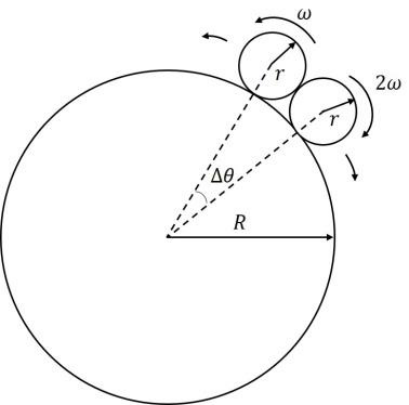
Consider a large disk of radius $R$ and two smaller disks, each of radius $r=R/50$, lying on its circumference, as shown in the figure. The smaller disks are initially in contact with each other, with an angular separation $\Delta\theta$ between their centers. They are made to roll without slipping in opposite directions, with constant angular velocities $\omega$ and $2\omega$ while the large disk is held stationary. The time $\tau$ at which the smaller disks are again in contact is:
[Use $\sin(\Delta\theta)=\Delta\theta$ and ignore gravity.]
Centers move on radius $R+r$ with orbital rates $\omega/51$ and $2\omega/51$. The complementary contact gap is $2\pi-4/51$ and relative rate $3\omega/51$, so $\tau=51(2\pi-4/51)/(3\omega)$: C.
Q2Electromagnetic InductionSingle correct
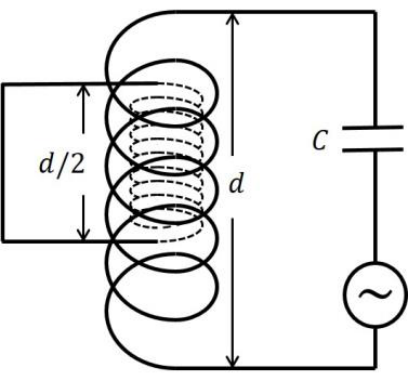
Consider a circuit consisting of a capacitor of capacitance $C$ and a coil with $N$ turns per unit length, cross sectional area $S$ and length $d$, where $d^2\gg S$. There is another coil of length $d/2$, cross sectional area $S/2$ and $2N$ turns per unit length completely inside the larger coil, as shown in the figure. The ends of this smaller coil are connected with each other by an insulated conducting wire. The self-inductance of the larger coil is $L$. Neglecting edge effects and all the Ohmic resistances, the resonant frequency of the circuit is:
(A)$\dfrac{4}{\sqrt{15LC}}$
(B)$\dfrac{6}{\sqrt{5LC}}$
(C)$\dfrac{2}{\sqrt{3LC}}$
(D)$\sqrt{\dfrac{2}{3LC}}$
Show answer and solution
Correct answer: (C)
Topic: Mutual Inductance
$L_2=\mu_0(2N)^2(S/2)(d/2)=L$ and $M=L/2$. The shorted secondary gives $L_{eff}=L-M^2/L_2=3L/4$, hence $\omega_0=2/\sqrt{3LC}$: C.
Q3Rotation & SystemSingle correct
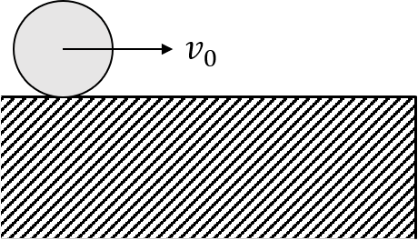
A solid cylinder of radius $R$ rolls without slipping with a center of mass speed $v_0 = \sqrt{\frac{gR}{3}}$ on a horizontal surface with a vertical edge, as shown in the figure. Here, $g$ is the acceleration due to the gravity. At the moment when the cylinder loses contact with the surface due to rotation around the corner, the speed of its center of mass is:
(A)$0$
(B)$\sqrt{\frac{5gR}{7}}$
(C)$\sqrt{\frac{gR}{15}}$
(D)$\sqrt{\frac{3gR}{7}}$
Show answer and solution
Correct answer: (B)
Topic: Pure Rolling Condition
Conserve angular momentum about the corner during impact, then mechanical energy during rotation. At loss of contact, radial dynamics gives $v^2/R=g\cos\phi$. Combining these relations for $I_{cm}=mR^2/2$ yields $v^2=5gR/7$, so B.
Q4Ray Optics and Optical InstrumentsSingle correct
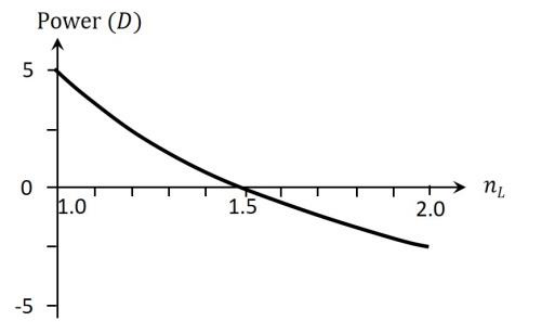
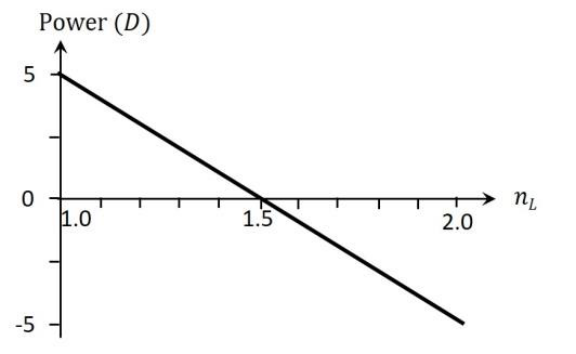
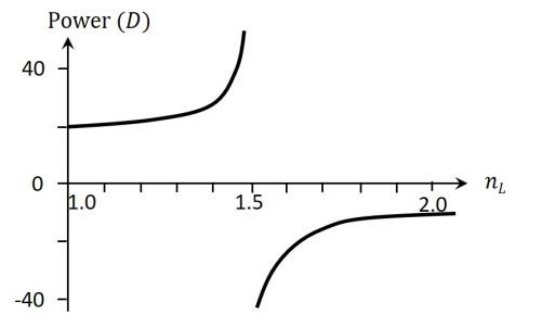
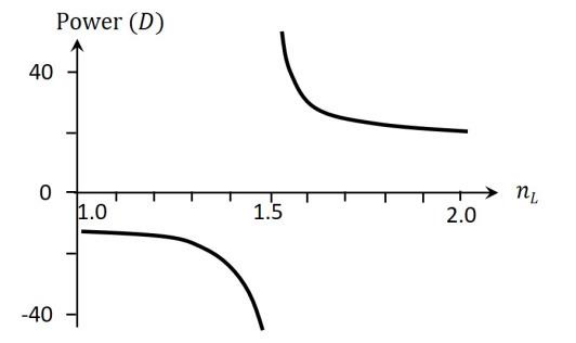
A double convex lens made of glass of refractive index 1.5 and radii of curvature of the curved surfaces 20 cm each is immersed in a liquid of refractive index $n_L$. The correct plot showing the variation of the power, in the units of diopter ($D$), as a function of $n_L$ is:
(A)Power ($D$); $n_L$; 5, 0, -5; 1.0, 1.5, 2.0
(B)Power ($D$); $n_L$; 5, 0, -5; 1.0, 1.5, 2.0
(C)Power ($D$); $n_L$; 40, 0, -40; 1.0, 1.5, 2.0
(D)Power ($D$); $n_L$; 40, 0, -40; 1.0, 1.5, 2.0
Show answer and solution
Correct answer: (A or B)
Topic: Power of a Lens
For a thin lens immersed in the same liquid on both sides, $$\frac{1}{f}=\left(\frac{n_g}{n_L}-1\right)\left(\frac{1}{R_1}-\frac{1}{R_2}\right).$$ Here $n_g=1.5$, $R_1=+0.20\,\mathrm m$, $R_2=-0.20\,\mathrm m$, so $$\frac{1}{f}=10\left(\frac{1.5}{n_L}-1\right)\,\mathrm{m^{-1}}.$$ If power is taken as $P=1/f$ in diopters, this is the decreasing nonlinear curve A: $P=5\,\mathrm D$ at $n_L=1$, zero at $n_L=1.5$, and negative for $n_L>1.5$. If optical power in the surrounding medium is taken as $P=n_L/f$, then $$P=15-10n_L\,\mathrm D,$$ which is the straight line B. Thus A or B is accepted depending on the power convention.
Q5AtomsOne or more correct
Consider a hydrogen atom with $v_k$, $r_k$, and $K_k$ denoting the velocity, orbital radius and kinetic energy of the electron in the $k^{\mathrm{th}}$ orbit, respectively. The electron undergoes a transition from the $n^{\mathrm{th}}$ orbit, emitting radiation corresponding to the Lyman series. Considering $h$ to be the Planck’s constant and $\epsilon_0$ the permittivity of the free space, the correct statement(s) is/are:
(A)Magnitude of change in kinetic energy of electron can be expressed as $\frac{h}{4\pi}\left|\frac{nv_n}{r_n}-\frac{v_1}{r_1}\right|$.
(B)Magnitude of change in de Broglie wavelength of the electron can be expressed as $\frac{e^2}{4\epsilon_0}\left|\frac{1}{K_n}-\frac{1}{K_1}\right|$.
(C)Frequency of the radiation emitted can be expressed as $\frac{e^2}{8\pi\epsilon_0 h}\left(\frac{1}{r_1}-\frac{1}{r_n}\right)$.
(D)Magnitude of change in total energy of the electron can be expressed as $\frac{h}{2\pi}\left|\frac{v_1}{r_1}-\frac{nv_n}{r_n}\right|$.
Show answer and solution
Correct answer: (A,C)
Topic: Energy of Electron in Hydrogen Atom
Bohr relations $mvr=nh/(2\pi)$ and $K=e^2/(8\pi\epsilon_0r)$ give A and $\nu=(K_1-K_n)/h=e^2(1/r_1-1/r_n)/(8\pi\epsilon_0h)$, giving C. B has wrong wavelength dependence and D a factor-of-2 error.
Q6Motion in a PlaneOne or more correct
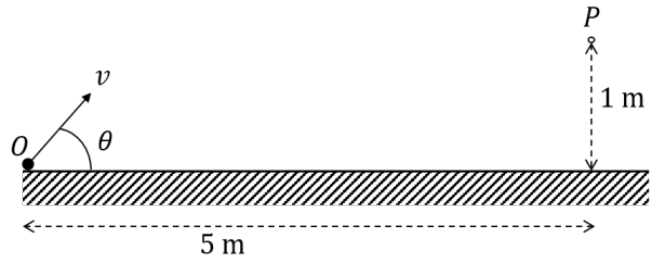
A particle is thrown with a speed $v$ from a point $O$ at an angle $\theta$ with the horizontal plane such that it passes through the point $P$ at a height of 1 m and horizontal distance of 5 m from $O$, as shown in the figure. If acceleration due to gravity is $g\ \mathrm{m\,s^{-2}}$, then the correct statement(s) is/are:
(A)If $\theta=45^\circ$, then $v=\frac{5\sqrt{g}}{2}\ \mathrm{m\,s^{-1}}$.
(B)If $\theta=45^\circ$, the particle reaches its maximum height before it reaches $P$.
(C)If $\theta=30^\circ$, the particle reaches its maximum height after reaching $P$.
(D)If $\theta=\tan^{-1}\left(\frac{1}{5}\right)$, then $v=125\sqrt{g}\ \mathrm{m\,s^{-1}}$.
Show answer and solution
Correct answer: (A,B)
Topic: Projectile Motion
At $(5,1)$, $1=5\tan\theta-25g\sec^2\theta/(2v^2)$. For $45^\circ$, $v=5\sqrt g/2$ and peak $x=v^2/(2g)=25/8<5$, so A,B. For $30^\circ$ peak is also before P; $\tan\theta=1/5$ cannot reach P for finite v. Thus A,B.
Q7ThermodynamicsOne or more correct
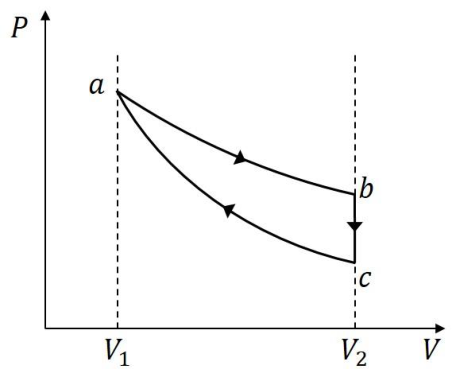
A quasi-static cycle of a monoatomic ideal gas contains an isothermal process ($ab$), followed by an isochoric process ($bc$) and an adiabatic process ($ca$) as shown in the figure. The volumes of the gas are $V_1$ and $V_2$ at $a$ and $b$, respectively. If the cycle has heat input $Q_{in}$ and output $Q_{out}$, then the efficiency of the cycle is defined as $\eta=\frac{Q_{in}-Q_{out}}{Q_{in}}$. The correct statement(s) is/are:
[Given: $\ln 2 \approx 0.7$]
(A)If $V_2/V_1=8$, the heat released in the process $bc$ is smaller than the heat absorbed in the process $ab$.
(B)For a given value of $V_2/V_1$, $\eta$ does not depend on the temperature of the isothermal process.
(C)If $V_2/V_1=8$, then the temperature of the gas at $a$ is 4 times the temperature of the gas at $c$.
(D)If $V_2/V_1=8$, then the pressure of the gas at $a$ is 4 times the pressure of the gas at $b$.
Show answer and solution
Correct answer: (A,B,C)
Topic: Carnot Engine and Reversible Limit
For monoatomic gas $\gamma=5/3$. With $V_2/V_1=8$, adiabatic $ca$ gives $T_a/T_c=8^{2/3}=4$ (C). $Q_{ab}=RT_a\ln8\approx2.1RT_a$ while $|Q_{bc}|=(3R/2)(3T_a/4)=1.125RT_a$ (A); their ratio is temperature-scale independent (B). Isothermal gives $P_a/P_b=8$, so D false.
Q8Electromagnetic WavesOne or more correct
The electric field associated with an electromagnetic wave travelling in vacuum is given by $E_0\sin(3y+4z+\omega t)\hat{i}$, where $\omega$ is the angular frequency. All quantities are in SI units. The correct statement(s) about this wave is/are:
[Given: speed of light in vacuum $c=3\times10^8\ \mathrm{m\,s^{-1}}$.]
(A)The wave is travelling in $-\frac{1}{5}(3\hat{j}+4\hat{k})$ direction.
(B)The magnitude of the wave vector is $0.5\ \mathrm{m^{-1}}$.
(C)The value of $\omega$ is $1.5\times10^9\ \mathrm{rad\,s^{-1}}$.
(D)The magnetic field associated with this wave is given by $\frac{E_0}{c}\sin(3y+4z+\omega t)(4\hat{j}-3\hat{k})$.
Show answer and solution
Correct answer: (A,C)
Topic: Nature and Propagation of Electromagnetic Waves
$\mathbf k=3\hat j+4\hat k$, and the plus sign before $\omega t$ means propagation along $-\mathbf k/|k|$, giving A. $|k|=5$ m$^{-1}$, so $\omega=c|k|=1.5\times10^9$ rad/s: C. Thus A,C.
Q9FluidsNumerical
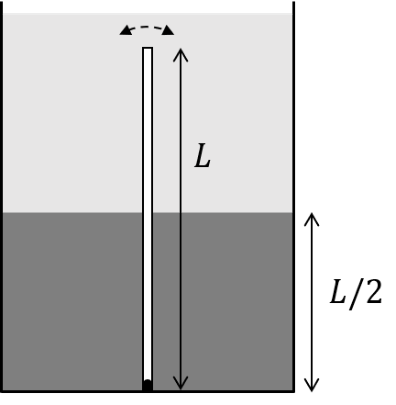
A tank contains two immiscible liquids of densities $6\rho$ and $2\rho$. The higher density liquid is filled up to a height $L/2$ from the bottom. A thin rod of density $\rho$ and length $L$ is fully immersed and hinged at the bottom so that it can oscillate freely, as shown in the figure. If the rod is slightly disturbed from its equilibrium, the time period of small oscillations is $$\frac{2\pi}{n}\sqrt{\frac{L}{g}},$$ where $g$ is the acceleration due to gravity. The value of $n$ is:
Show answer and solution
Correct answer: 1.73
Topic: Buoyant Force
For small angle, buoyancy torques of the two half-length portions minus weight give restoring torque $-\rho AL^2g\theta$. With $I=\rho AL^3/3$, $\omega_0^2=3g/L$, so $n=\sqrt3\approx1.73$.
Q10ThermodynamicsNumerical
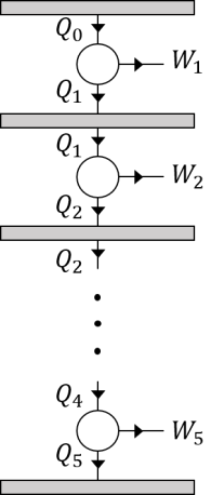
As shown in the figure, five Carnot engines, each with efficiency $\eta$ and same number of cycles per unit time, are operating between six heat reservoirs. The amount of heat released per cycle by one engine is completely absorbed by the next engine. Consider $Q_0$ to be the amount of heat absorbed per cycle by the first engine and $W$ as the amount of total work done by all the engines per cycle, then the net efficiency of the system is found to be $$\eta_{\mathrm{net}}=\frac{W}{Q_0}=\frac{211}{243}.$$ The value of $\eta$ is:
Show answer and solution
Correct answer: 0.33
Topic: Carnot Efficiency
After five equal-efficiency Carnot engines, rejected heat is $Q_0(1-\eta)^5$. Hence $1-(1-\eta)^5=211/243$, so $(1-\eta)^5=(2/3)^5$ and $\eta=1/3=0.33$.
Q11ThermodynamicsNumerical
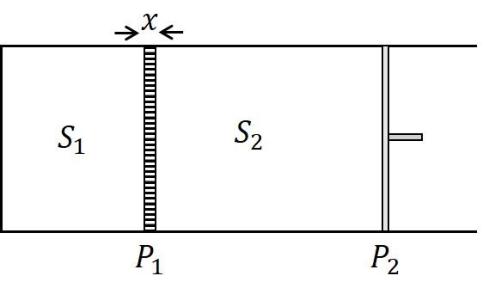
As shown in the figure, an insulated container is fitted with a thermally conducting but immovable partition ($P_1$) and a freely movable but thermally insulated piston ($P_2$). The partition $P_1$ with thermal conductivity $K$, cross sectional area $A$ and width $x$ divides the container into two sections, $S_1$ and $S_2$, each containing one mole of a monoatomic gas. The piston $P_2$ moves freely such that the gas in $S_2$ is always at the atmospheric pressure. Initially, the difference between the temperatures of $S_1$ and $S_2$ is $\Delta T_0$. The time it takes for the temperature difference to become $\frac{\Delta T_0}{2}$ is $nxR/KA$, where $R$ is the universal gas constant. The value of $n$ is:
[ Given: $\ln 2 \approx 0.7$ ]
Show answer and solution
Correct answer: 0.66
Topic: First Law of Thermodynamics
Conduction gives $\dot Q=KA\Delta T/x$. Using $C_V=3R/2$ for rigid $S_1$ and $C_P=5R/2$ for constant-pressure $S_2$ gives $d\Delta T/dt=-(16KA/(15Rx))\Delta T$. Halving time is $15Rx\ln2/(16KA)$, hence $n\approx15(0.7)/16=0.66$.
Q12Moving Charges and MagnetismNumerical
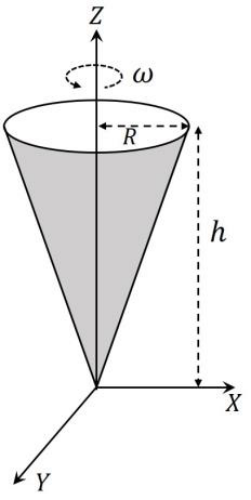
A hollow, right circular cone of base radius $R$ and height $h$, with its tip at the origin is rotating about the Z-axis with an angular velocity $\omega$, as shown in the figure. The cone carries a total charge $Q$ uniformly distributed on its curved surface. The magnitude of magnetic field at a point $(0,0,z)$, where $z\gg R$ and $z\gg h$, is $$\frac{n\mu_0 Q R^2\omega}{4\pi z^3}.$$ The value of $n$ is:
Show answer and solution
Correct answer: 0.50
Topic: Field on the Axis of a Circular Current Loop
Integrating rotating surface charge rings gives magnetic moment $\mu=Q\omega R^2/4$. Far on axis $B=\mu_0(2\mu)/(4\pi z^3)=\mu_0QR^2\omega/(8\pi z^3)$, so $n=0.50$.
Q13WavesSingle correct
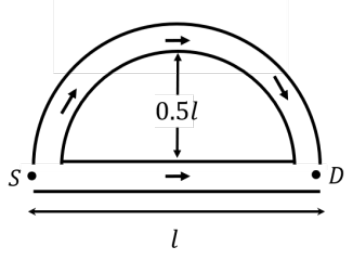
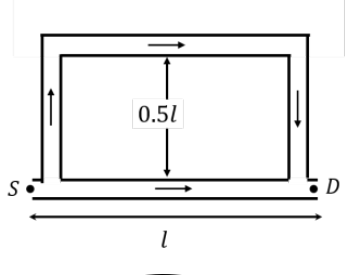
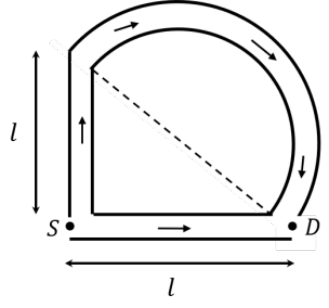
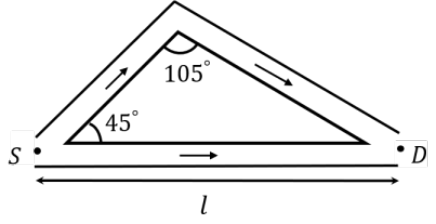
List-I shows four configurations made of straight and semi-circular narrow tubes containing air. A sound wave of wavelength $\lambda = 0.29\ \mathrm{m}$ enters these structures at the point $S$ and a sound detector is placed at $D$. Between the points $S$ and $D$, the sound travels only through the tubes. List-II contains the possible smallest values of $l$ (refer to the figures) for which the detector $D$ records maximum amplitude. Ignore effects of sharp corners. [Given $\cos(15^\circ)=0.97$]
Choose the option that best describes the match between the entries in List-I to those in List-II.
List-I: (P) [figure], (Q) [figure], (R) [figure], (S) [figure]
List-II: (1) $1.32\ \mathrm{m}$; (2) $1.19\ \mathrm{m}$; (3) $0.51\ \mathrm{m}$; (4) $0.29\ \mathrm{m}$; (5) $0.13\ \mathrm{m}$
(A)P→4, Q→3, R→5, S→1
(B)P→4, Q→3, R→1, S→5
(C)P→3, Q→4, R→1, S→2
(D)P→3, Q→4, R→5, S→2
Show answer and solution
Correct answer: (D)
Topic: Progressive and Standing Waves
Constructive interference requires path difference $m\lambda$. From the four geometries, the smallest lengths are P=0.51 m (3), Q=0.29 m (4), R=0.13 m (5), S=1.19 m (2). Therefore option D.
Q14Ray Optics and Optical InstrumentsWave OpticsSingle correct
In the List-I, four optical effects are mentioned. The physical phenomena of light which are essential to describe these optical effects are given in List-II. Choose the option which describes the correct match between the entries in List-I to those in List-II.
List-I:
(P) Colorful sky in north polar region (Aurora Borealis)
(Q) Partially polarized sun light
(R) Rainbow
(S) Dark and bright fringes
List-II:
(1) Dispersion and reflection
(2) Total internal reflection
(3) Diffraction
(4) Scattering of light by molecules in the atmosphere
(5) Emission of radiation from oxygen and nitrogen atoms excited by charged particles
(A)P→5, Q→4, R→1, S→3
(B)P→4, Q→2, R→1, S→3
(C)P→4, Q→1, R→2, S→3
(D)P→5, Q→4, R→1, S→2
Show answer and solution
Correct answer: (A)
Topic: Total Internal Reflection, Single-Slit Diffraction
Aurora is emission from excited atmospheric O/N (5); partial polarization of sunlight is atmospheric scattering (4); rainbow needs dispersion plus reflection (1); dark/bright fringes require diffraction/interference (3). Thus A.
Q15Electromagnetic InductionSingle correct
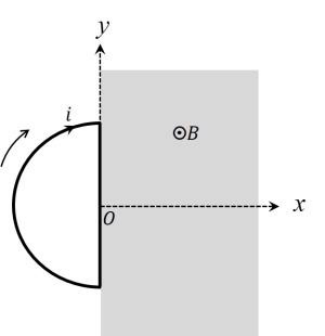
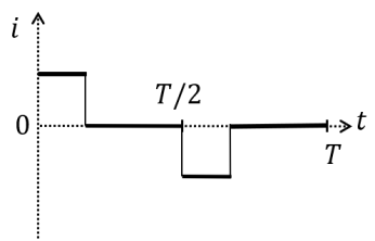
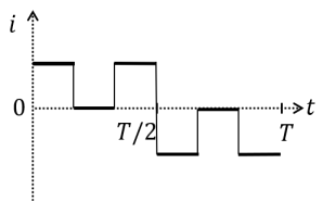
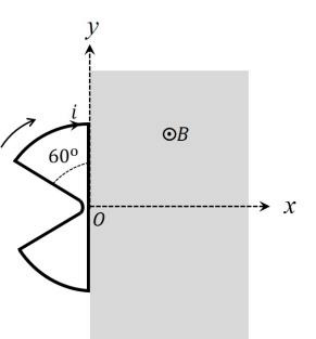
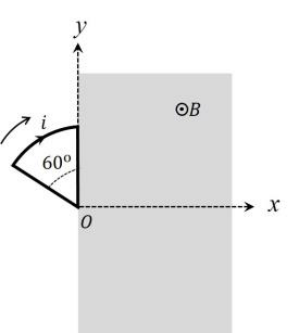
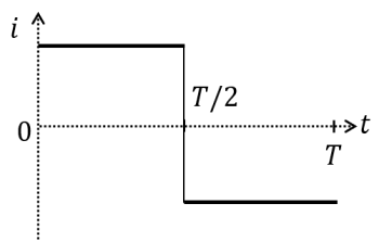
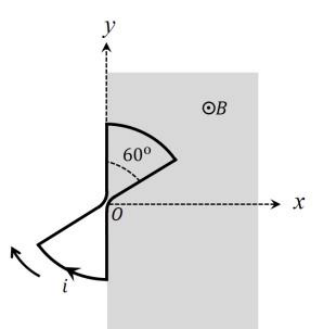
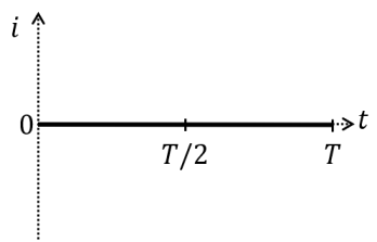
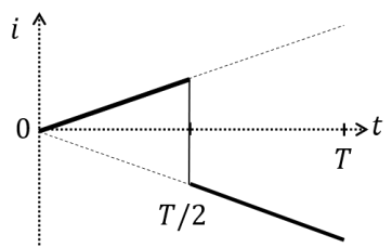
List-I contains four conducting loops lying in the $XY$ plane, as shown in the figures. The loops are rotating about $Z$ axis passing through the point $O$ with time period $T$ in clockwise direction. The region $x>0$ contains a uniform magnetic field $B$ in the $+z$ direction. List-II contains the qualitative variation of the induced current $i(t)$ for each of these loops. Choose the option which describes the correct match between the entries in List-I to those in List-II.
List-I: (P), (Q), (R), (S).
List-II: (1), (2), (3), (4), (5).
(A)P $\to$ 5, Q $\to$ 4, R $\to$ 1, S $\to$ 3
(B)P $\to$ 3, Q $\to$ 2, R $\to$ 5, S $\to$ 4
(C)P $\to$ 3, Q $\to$ 2, R $\to$ 1, S $\to$ 4
(D)P $\to$ 5, Q $\to$ 1, R $\to$ 2, S $\to$ 3
Show answer and solution
Correct answer: (C)
Topic: Faraday's Laws of Electromagnetic Induction
Magnetic flux is $B$ times the loop area lying in $x>0$; induced current is proportional to $-d\Phi/dt$. Tracking each drawn loop through one rotation gives P$\to3$, Q$\to2$, R$\to1$, S$\to4$, hence C.
Q16Rotation & SystemSingle correct
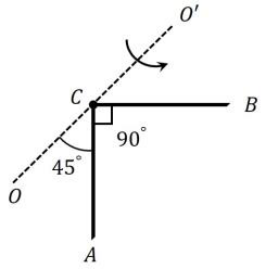
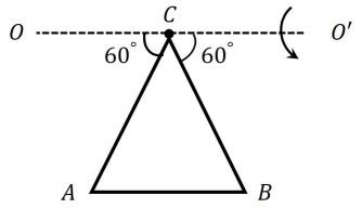
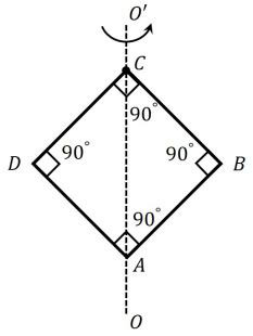
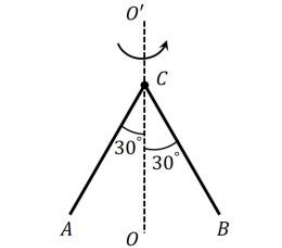
List-I shows four planar structures made of uniform solid rods each of mass $m$ and length $l$. In the List-II the possible moment of inertia of these structures about an axis $OCO'$, which lies in the plane of the structures, are given. Choose the option that describes the correct match between the entries in List-I to those in List-II.
List-II: (1) $\frac{5}{4}ml^2$, (2) $\frac{1}{6}ml^2$, (3) $\frac{1}{12}ml^2$, (4) $\frac{2}{3}ml^2$, (5) $\frac{1}{3}ml^2$.
(A)P $\to$ 5, Q $\to$ 1, R $\to$ 4, S $\to$ 2
(B)P $\to$ 1, Q $\to$ 3, R $\to$ 4, S $\to$ 2
(C)P $\to$ 5, Q $\to$ 3, R $\to$ 2, S $\to$ 1
(D)P $\to$ 5, Q $\to$ 4, R $\to$ 2, S $\to$ 1
Show answer and solution
Correct answer: (A)
Topic: Moment of Inertia of Continuous Bodies
For each rod use $I=(ml^2/12)+md^2$ about the shown in-plane axis, or $I=(ml^2/3)\sin^2\theta$ about an axis through an end. Summing rods in each figure gives P$\to5$, Q$\to1$, R$\to4$, S$\to2$, hence A.
Chemistry
Q1Chemical ThermodynamicsSingle correct
An ideal gas (0.5 mol), initially at 2 bar pressure, is compressed at a constant temperature of 600 K in two steps: first, against a constant external pressure of $P$ bar ($2<P<8$), and then against constant external pressure of 8 bar. At each step, the compression is stopped only when the pressure of the gas becomes equal to the external pressure. The total work done on the gas in these steps is $W$. Considering all possible values of $P$ ($2<P<8$) and taking the gas constant as $R$ (in $\mathrm{J\ K^{-1}\ mol^{-1}}$), the minimum value of $|W|$ (in J) is
(A)$207R$
(B)$600R$
(C)$630R$
(D)$900R$
Show answer and solution
Correct answer: (B)
Topic: Thermodynamic System and Basic Concepts
For each irreversible isothermal step, $w=-P_{ext}\Delta V$ with $V=nRT/P$. Thus $|W|=nRT(P/2+8/P-2)$. Minimizing gives $1/2-8/P^2=0$, so $P=4$ bar and $|W|=(0.5)(600)R(2)=600R$: B.
Q2Chemical KineticsSingle correct
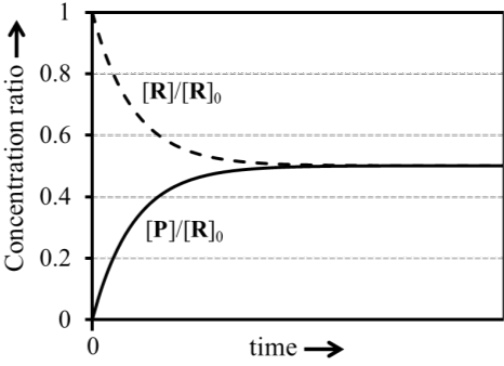
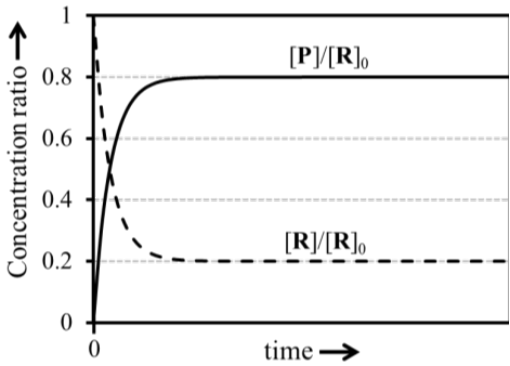
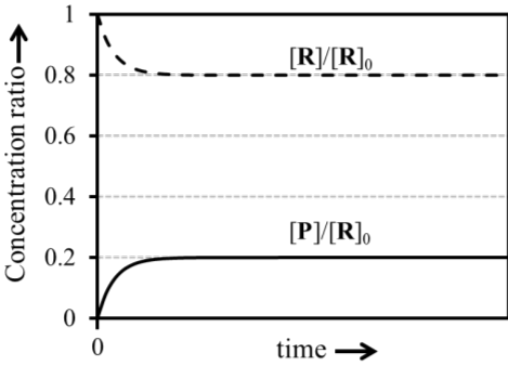
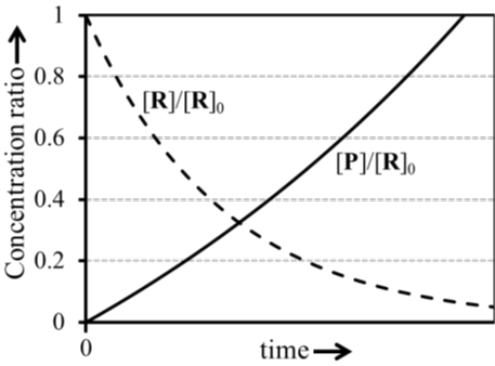
For a reversible reaction $\mathrm{R \rightleftharpoons P}$, at constant temperature, both the forward and the backward reactions are first order elementary reactions with rate constants $k_f$ and $k_b$, respectively. At time zero, the concentration of R is $[\mathrm{R}]_0$ and the concentration of P is zero. At any given time, $[\mathrm{R}]$ and $[\mathrm{P}]$ are the concentrations of R and P, respectively. If $k_b=4k_f$, the correct graphical representation of the reaction is
At equilibrium $k_f[R]=k_b[P]=4k_f[P]$, so $[R]=4[P]$. Conservation gives $[R]_{eq}=0.8[R]_0$ and $[P]_{eq}=0.2[R]_0$. The graph starting at 1 and 0 and approaching 0.8 and 0.2 is C.
Q3Chemical Bonding and Molecular StructureSingle correct
The correct order of dipole moments for the given species is
$BF_3$ and $NH_4^+$ are symmetric, so $\mu=0$. $NF_3$ is pyramidal but its bond and lone-pair contributions oppose strongly, while in $NH_3$ they reinforce. Hence $BF_3=NH_4^+<NF_3<NH_3$: A.
Q4Aldehydes, Ketones and Carboxylic AcidsSingle correct
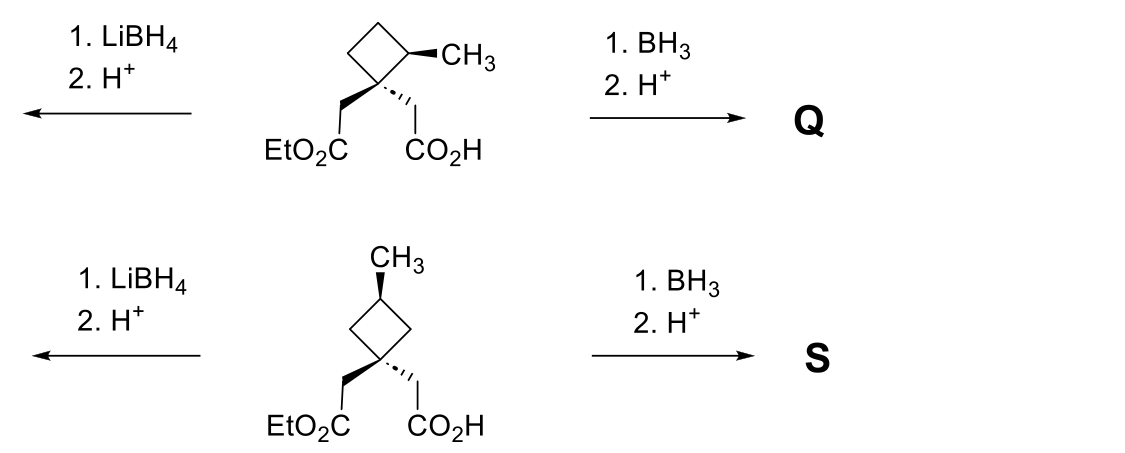
Considering $\mathrm{LiBH_4}$ reduces an ester group to the corresponding alcohol and does not reduce a carboxylic acid group, the correct statement about the major products P, Q, R and S is
(A)P & Q are identical, and R & S are diastereomers.
(B)P & Q are diastereomers, and R & S are identical.
(C)P & Q are diastereomers, and R & S are diastereomers.
(D)P & Q are identical, and R & S are identical.
Show answer and solution
Correct answer: (C)
Topic: Reduction of Carbonyl Compounds
$LiBH_4$ reduces the ester but leaves $CO_2H$; $BH_3$ selectively reduces the acid. Reading the stereochemistry in the two substrates, the top pair P,Q become diastereomeric and the bottom pair R,S also become diastereomeric. Therefore C.
Q5Structure of AtomOne or more correct
The $2s$ and the $2p$ orbital energies of hydrogen atom are $E_{2s}(\mathrm{H})$ and $E_{2p}(\mathrm{H})$, respectively. The $2s$ and the $2p$ orbital energies of lithium atom are $E_{2s}(\mathrm{Li})$ and $E_{2p}(\mathrm{Li})$, respectively. The correct option(s) about the orbital energies is(are)
(A)$E_{2s}(\mathrm{Li}) < E_{2p}(\mathrm{Li})$
(B)$E_{2s}(\mathrm{H}) = E_{2p}(\mathrm{H})$
(C)$E_{2p}(\mathrm{H}) < E_{2s}(\mathrm{Li})$
(D)$E_{2s}(\mathrm{H}) > E_{2s}(\mathrm{Li})$
Show answer and solution
Correct answer: (A,B,D)
Topic: Shapes and orientation of orbitals
Hydrogen has $n$-degeneracy, so $E_{2s}(H)=E_{2p}(H)$. In Li, 2s penetrates more and is lower than 2p; Li 2s is also lower than H 2s/2p. Hence A,B,D are true and C false.
Q6Redox ReactionsOne or more correct
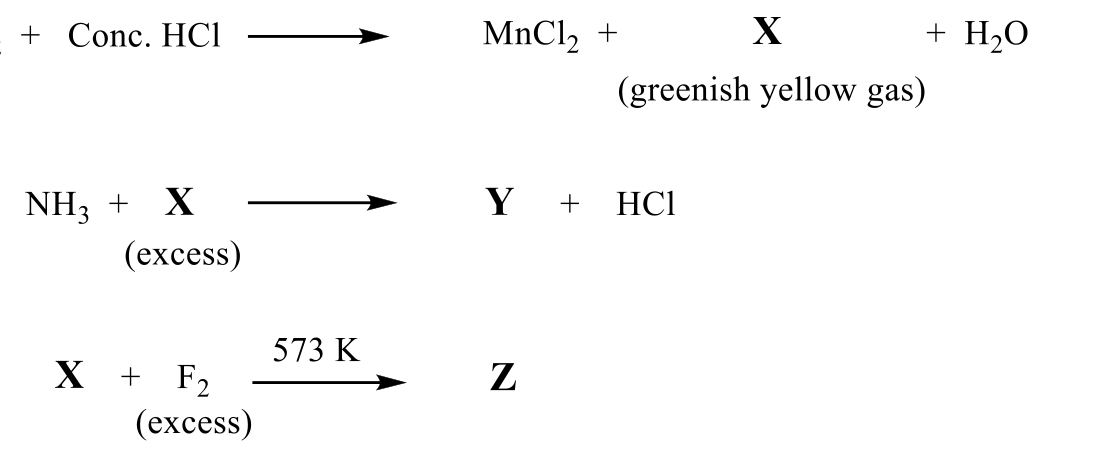
Correct statement(s) about the compounds $\mathbf{X}$, $\mathbf{Y}$ and $\mathbf{Z}$ is(are)
(A)$\mathbf{X}$ is used for sterilizing drinking water.
(B)$\mathbf{Y}$ has a planar structure.
(C)$\mathbf{Z}$ is used in the enrichment of $^{235}\mathrm{U}$.
(D)$\mathbf{Y}$ is a stronger Lewis base than ammonia.
Show answer and solution
Correct answer: (A,C)
Topic: Oxidation Number, Oxidation State, Oxidants and Reductants
From $MnO_2+HCl$, X is $Cl_2$; excess chlorine with $NH_3$ gives Y=$NCl_3$; fluorination gives Z=$ClF_3$. Chlorine disinfects water (A), $NCl_3$ is pyramidal and less basic than $NH_3$, and $ClF_3$ is used to fluorinate uranium compounds to volatile $UF_6$ for enrichment (C). Thus A,C.
Q7Chemical Bonding and Molecular StructureOne or more correct
Reaction of $\mathrm{PtF_6}$ with oxygen ($\mathrm{O_2}$) gas results in the formation of an ionic compound, $\mathbf{X^+Y^-}$. Correct statement(s) is(are)
(A)The bond order of $\mathbf{X^+}$ is $1.5$.
(B)Valence $d$-orbitals of the metal ion in $\mathbf{X^+Y^-}$ has $5$ electrons.
(C)$\mathrm{PtF_6}$ acts as an oxidant in this reaction.
(D)$\mathrm{PtF_6}$ acts as a fluorinating agent in this reaction.
Show answer and solution
Correct answer: (B,C)
Topic: Molecular Orbital Theory
$PtF_6$ oxidizes $O_2$ to $O_2^+$, forming $[O_2]^+[PtF_6]^-$, so C. In $PtF_6^-$ platinum is +5, i.e. $5d^5$, so B. $O_2^+$ has bond order 2.5, not 1.5, and no fluorine is transferred to oxygen; A,D false.
Q8Aldehydes, Ketones and Carboxylic AcidsOne or more correct
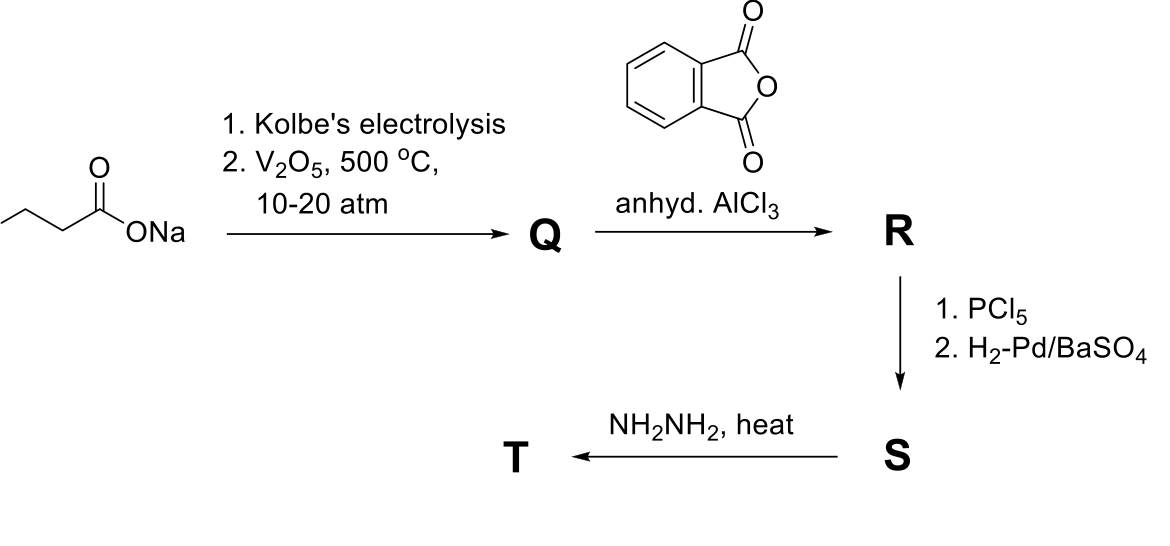
In the following reaction sequence, $\mathbf{Q}$, $\mathbf{R}$, $\mathbf{S}$ and $\mathbf{T}$ are the major products.
The correct statement(s) about $\mathbf{Q}$, $\mathbf{R}$, $\mathbf{S}$ and $\mathbf{T}$ is(are)
(A)$\mathbf{S}$ on warming with ammoniacal $\mathrm{AgNO_3}$ results in the formation of silver mirror.
(B)$\mathbf{Q}$ on treatment with $\mathrm{Cl_2(excess)/UV}$ gives gammaxane.
(C)$\mathbf{T}$ is a heterocyclic compound.
(D)$\mathbf{R}$ on acid catalyzed intramolecular cyclization followed by treatment with $\mathrm{Zn-Hg/HCl}$ gives 9,10-dihydroxyanthracene.
Show answer and solution
Correct answer: (A,B,C)
Topic: Reduction of Carbonyl Compounds
Follow the complete sequence shown in the paper.
Kolbe electrolysis of sodium butyrate couples two propyl radicals:
$$2\,\mathrm{CH_3CH_2CH_2COO^-}\longrightarrow
\mathrm{CH_3(CH_2)_4CH_3}+2CO_2.$$
The resulting $n$-hexane is then passed over $\mathrm{V_2O_5}$ at $500^\circ\mathrm C$ and $10$–$20$ atm, where it undergoes dehydrocyclization/aromatization to benzene. Therefore $\mathbf Q$ is benzene. Consequently, excess $\mathrm{Cl_2}$ under UV adds to benzene to give benzene hexachloride; the $\gamma$-isomer is gammaxane. Thus B is true.
Benzene reacts with phthalic anhydride/anhydrous $\mathrm{AlCl_3}$ by Friedel–Crafts acylation to give $o$-benzoylbenzoic acid $\mathbf R$. Treatment of its $-\mathrm{CO_2H}$ group with $\mathrm{PCl_5}$ gives the acid chloride, and Rosenmund reduction $\mathrm{H_2/Pd-BaSO_4}$ converts that acid chloride to $-\mathrm{CHO}$ without reducing the benzophenone carbonyl. Hence $\mathbf S$ contains an aldehyde group and gives Tollens' silver-mirror test: A is true.
Heating $\mathbf S$ with hydrazine condenses the two carbonyl functions into a nitrogen-containing ring, so $\mathbf T$ is heterocyclic: C is true.
For D, acid-catalyzed cyclization of $o$-benzoylbenzoic acid gives the anthraquinone framework; subsequent Clemmensen reduction reduces carbonyl groups rather than producing 9,10-dihydroxyanthracene. Hence D is false.
Therefore the complete correct set is A,B,C.
Q9Some Basic Concepts of ChemistryNumerical
Two cylinders, both fitted with frictionless pistons, are filled with mixtures of He and Ar gases. In the first cylinder, the masses of He and Ar are $m_1$ and $m_2$, respectively. In the second cylinder, the masses of He and Ar are $m_2$ and $m_1$, respectively. The molar mass of Ar is 10 times the molar mass of He. The external pressure applied by the piston on the first cylinder needs to be 5 times that on the second cylinder so that the volume of the gas mixtures in both the cylinders are equal at the same temperature. Assuming He and Ar behave like ideal gases, the value of $(m_1/m_2)$ is ____.
Show answer and solution
Correct answer: 9.80
Topic: Molar volume and gas mole calculations
At equal $V,T$, pressure is proportional to total moles. Thus $(10m_1+m_2)/(10m_2+m_1)=5$, so $10m_1+m_2=50m_2+5m_1$, giving $m_1/m_2=49/5=9.80$.
Q10Coordination CompoundsNumerical
The total number of all possible isomers for the square planar complex with formula $\mathrm{K[M(NCS)(NO_2)(gly)]}$ is ____.
$(\mathrm{M = metal\ ion\ and\ gly = NH_2CH_2COO^-})$
Show answer and solution
Correct answer: 8
Topic: Stereoisomerism
The bidentate gly ligand occupies adjacent sites. NCS has two linkage modes and $NO_2$ has two linkage modes; for each linkage combination there are two distinct geometric arrangements relative to the N/O ends of gly. Total $2\times2\times2=8$.
Q11Aldehydes, Ketones and Carboxylic AcidsNumerical
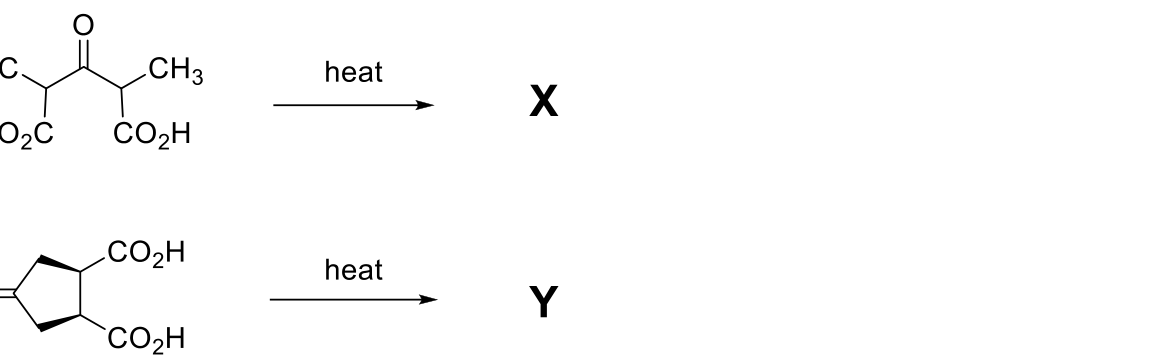
The sum of total number of carbonyl groups ($>\mathrm{C}=\mathrm{O}$) present in the major products X and Y in the following reactions is ____.
Show answer and solution
Correct answer: 4
Topic: Aldol Condensation
For the first substrate, each $-\mathrm{CO_2H}$ group is part of a $\beta$-keto-acid arrangement with the central ketone. On heating, $\beta$-keto acids decarboxylate. Both carboxyl groups are lost successively as $CO_2$, leaving the ketone $\mathbf X$ (pentan-3-one). Thus $\mathbf X$ contains one $>\!C=O$ group.
In the second substrate the two carboxyl groups are cis and vicinal on the cyclopentanone ring. On heating they undergo intramolecular dehydration to form a five-membered cyclic anhydride. The original cyclopentanone carbonyl remains. Therefore $\mathbf Y$ contains three carbonyl groups: one ketone carbonyl plus two anhydride carbonyls.
Hence the required total is
$$1+3=\boxed{4}.$$
Q12HydrocarbonsNumerical
Treatment of buta-1,3-diyne with $\mathrm{NaNH_2}$ (2 equivalents), followed by reaction with excess of $\mathit{trans}\text{-}\mathrm{CH_3-CH=CH-CH_2-Br}$ gives X as the major product. The maximum number of carbon atoms that are collinear (in a straight line) in X is ____.
Show answer and solution
Correct answer: 6
Topic: Acidity of terminal alkynes
Two equivalents of $NaNH_2$ remove both terminal acetylenic protons of buta-1,3-diyne, and alkylation at both ends gives $R- C\equiv C-C\equiv C-R$. The four sp carbons form one straight chain; including the directly attached terminal carbon at each end extends the maximum collinear set to 6 carbon atoms. Answer 6.
Q13Chemical ThermodynamicsSingle correct
List-I contains various physical/chemical processes, and List-II contains combinations of changes in enthalpy ($\Delta H$) and entropy ($\Delta S$). Match each entry in List-I to the appropriate entry in List-II, and choose the correct option.
List-I
(P) Physisorption
(Q) Diamond $\longrightarrow$ Graphite
(R) Denaturation of protein
(S) Propene $\longrightarrow$ Cyclopropane
List-II
(1) $\Delta H>0$ and $\Delta S>0$
(2) $\Delta H<0$ and $\Delta S<0$
(3) $\Delta H<0$ and $\Delta S=0$
(4) $\Delta H>0$ and $\Delta S<0$
(5) $\Delta H<0$ and $\Delta S>0$
(A)P $\to$ 2; Q $\to$ 3; R $\to$ 5; S $\to$ 4
(B)P $\to$ 4; Q $\to$ 3; R $\to$ 5; S $\to$ 1
(C)P $\to$ 2; Q $\to$ 5; R $\to$ 1; S $\to$ 4
(D)P $\to$ 2; Q $\to$ 5; R $\to$ 1; S $\to$ 3
Show answer and solution
Correct answer: (C)
Topic: Spontaneity and Entropy
Physisorption is $\Delta H<0,\Delta S<0$ (2). Diamond$\to$graphite is $\Delta H<0,\Delta S>0$ (5). Protein denaturation is endothermic with increased disorder (1). Propene$\to$cyclopropane is endothermic and decreases conformational freedom (4). Mapping $2,5,1,4$ is C.
Q14Chemical Bonding and Molecular StructureSingle correct
Consider the following species:
$\mathrm{SOCl_2,\ XeOF_4,\ ClF_3,\ ClF_5,\ XeF_5^+,\ SO_3^{2-},\ XeF_3^+,\ SF_4}$
List-I contains different molecular shapes and List-II contains total number of species with the same molecular shapes from the given species. Match each entry in List-I with the appropriate entry in List-II and choose the correct option.
List-I
(P) See-saw
(Q) T-Shaped
(R) Trigonal Planar
(S) Square Pyramidal
List-II
(1) one
(2) two
(3) three
(4) four
(5) zero
(A)P $\to$ 1; Q $\to$ 2; R $\to$ 5; S $\to$ 3
(B)P $\to$ 5; Q $\to$ 4; R $\to$ 2; S $\to$ 3
(C)P $\to$ 3; Q $\to$ 2; R $\to$ 1; S $\to$ 4
(D)P $\to$ 1; Q $\to$ 3; R $\to$ 5; S $\to$ 4
Show answer and solution
Correct answer: (A)
Topic: VSEPR Theory
VSEPR: SF4 is see-saw (one species); ClF3 and XeF3+ are T-shaped (two); none listed is trigonal planar; XeOF4, ClF5 and XeF5+ are square pyramidal (three). Thus P$\to1$,Q$\to2$,R$\to5$,S$\to3$: A.
Q15Aldehydes, Ketones and Carboxylic AcidsSingle correct
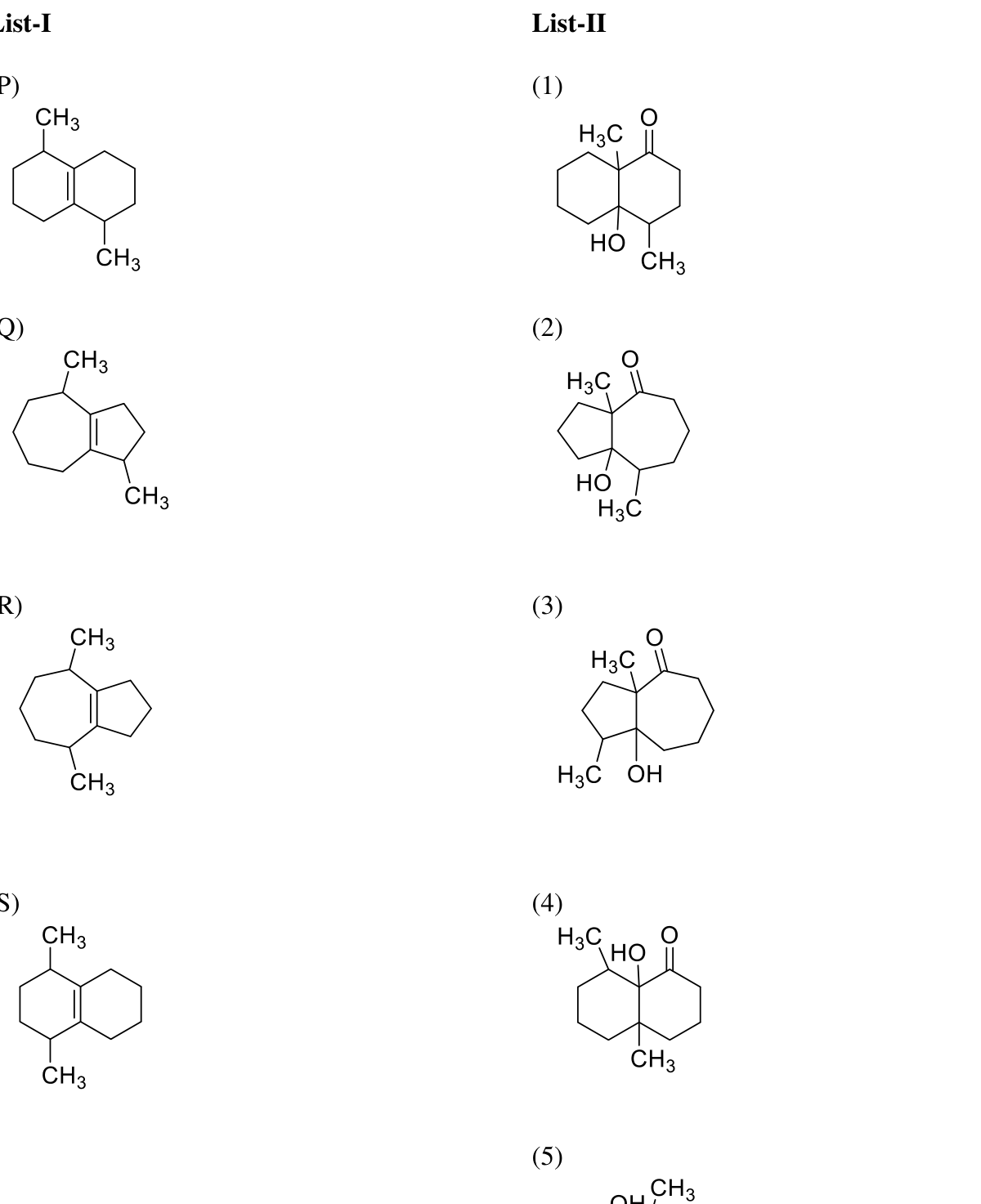
The List-II contains products obtained from the reaction of compounds in List-I with $\mathrm{O_3/Zn-H_2O}$ followed by cyclization (via more stable enolate) in the presence of aqueous $\mathrm{NaOH}$. Match each entry in List-I with appropriate entry in List-II and choose the correct option.
List-I: (P), (Q), (R), (S)
List-II: (1), (2), (3), (4), (5)
(A)P $\longrightarrow$ 2; Q $\longrightarrow$ 4; R $\longrightarrow$ 1; S $\longrightarrow$ 3
(B)P $\longrightarrow$ 3; Q $\longrightarrow$ 4; R $\longrightarrow$ 5; S $\longrightarrow$ 2
(C)P $\longrightarrow$ 2; Q $\longrightarrow$ 1; R $\longrightarrow$ 5; S $\longrightarrow$ 3
(D)P $\longrightarrow$ 3; Q $\longrightarrow$ 5; R $\longrightarrow$ 4; S $\longrightarrow$ 2
Show answer and solution
Correct answer: (C)
Topic: Aldol Condensation
Reductive ozonolysis cleaves the alkene in each fused-ring substrate to the corresponding dicarbonyl compound. Under aqueous $\mathrm{NaOH}$, cyclization occurs through the more stable enolate; comparing the ring size and the positions of the two methyl substituents with List-II gives $P\to2$, $Q\to1$, $R\to5$, and $S\to3$. Hence the matching set is option C. The mapping also agrees with the official final key.
Q16AminesSingle correct
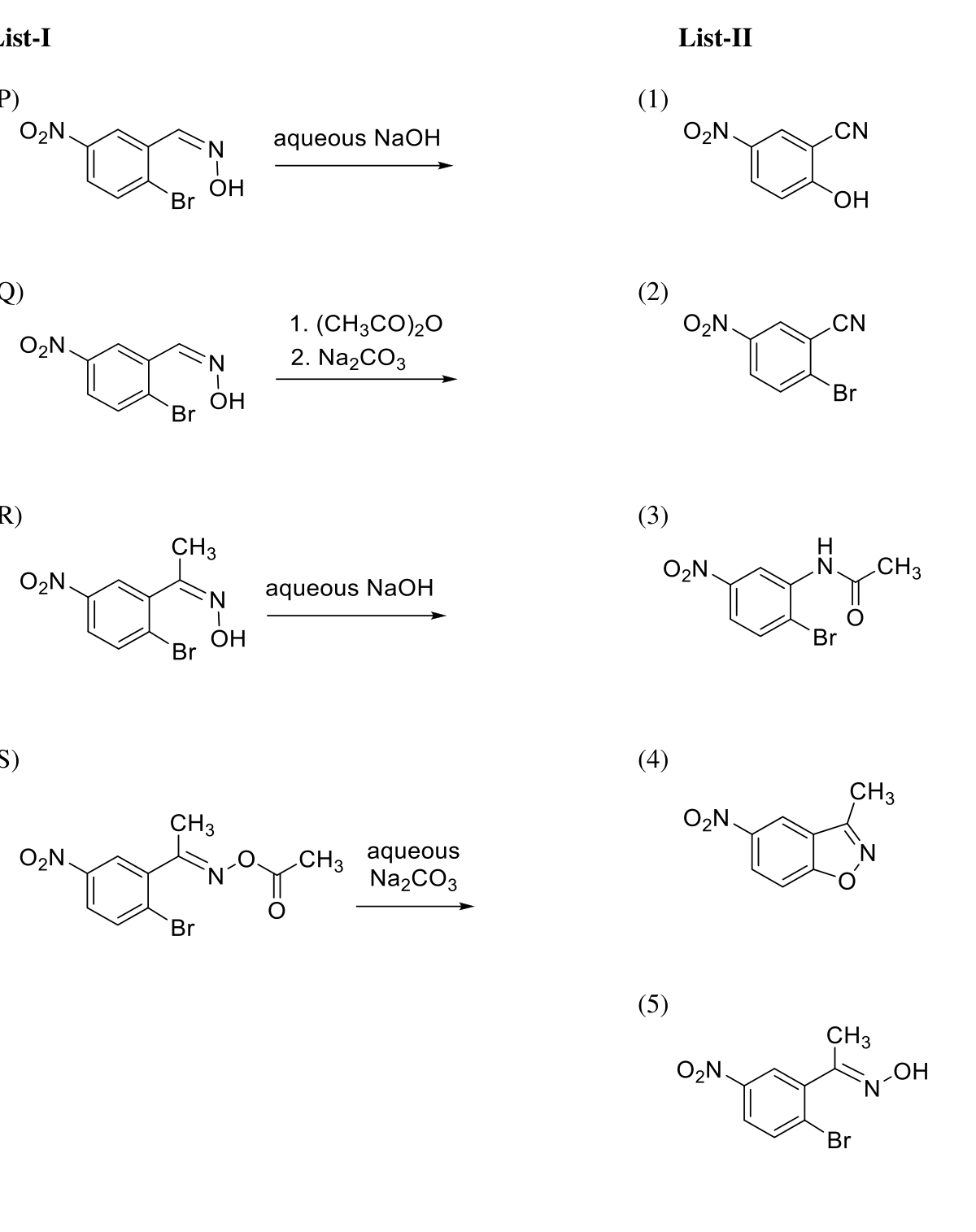
Match the major products obtained in the reactions given in List-I with the corresponding structures in List-II and choose the correct option.
List-I: (P), (Q), (R), (S)
List-II: (1), (2), (3), (4), (5)
(A)P $\to$ 2; Q $\to$ 1; R $\to$ 5; S $\to$ 4
(B)P $\to$ 1; Q $\to$ 2; R $\to$ 4; S $\to$ 5
(C)P $\to$ 1; Q $\to$ 2; R $\to$ 3; S $\to$ 4
(D)P $\to$ 2; Q $\to$ 1; R $\to$ 3; S $\to$ 5
Show answer and solution
Correct answer: (B)
Topic: Reactions of Amines
For P, aqueous $\mathrm{NaOH}$ converts the aryl bromide to the phenolic product while the aldoxime dehydrates to the nitrile, giving structure (1). For Q, acetylation of the oxime followed by $\mathrm{Na_2CO_3}$ promotes dehydration to the nitrile without replacing aryl Br, giving (2). For R, base-promoted intramolecular cyclization of the $o$-bromo ketoxime gives the methyl benzisoxazole, structure (4). For S, aqueous $\mathrm{Na_2CO_3}$ hydrolyzes the $O$-acetyl oxime back to the oxime, structure (5). Thus $P\to1$, $Q\to2$, $R\to4$, $S\to5$, so option B.
These papers are open for everyone. With an account you get all 60 JEE papers sorted chapter-wise and topic-wise, plus chapter trees, formula summaries and practice for JEE & NEET.
 JEE NEET AI