JEE Main 2025 (22 Jan, Shift 1) question paper with solutions
All 75 questions of this paper (Mathematics, Physics, Chemistry) with options, the correct answer and a worked
solution. Each question also shows the NCERT chapter and topic it is based on, so you know exactly what to revise.
Mathematics
Q1Sequences & SeriesSingle correct
Let $a_1,a_2,a_3,\ldots$ be a G.P. of increasing positive terms. If $a_1a_5=28$ and $a_2+a_4=29$, then $a_6$ is equal to:
(1)628
(2)812
(3)526
(4)784
Show answer and solution
Correct answer: (4)
Topic: Geometric Progression
Let the common ratio of the increasing positive G.P. be $r>1$. Since terms equidistant from $a_3$ have equal products, $a_2a_4=a_1a_5=28$. We also know $a_2+a_4=29$. Thus $a_2$ and $a_4$ are the roots of
$$t^2-29t+28=(t-1)(t-28)=0.$$
As the G.P. is increasing, $a_2=1$ and $a_4=28$ (not the reverse). Two steps of the G.P. multiply by $r^2$, so
$$r^2=\frac{a_4}{a_2}=28,\qquad a_6=a_4r^2=28\times28=\boxed{784}.$$
The correct printed choice is **(4)**.
Q2Differential EquationsSingle correct
Let $x=x(y)$ be the solution of the differential equation $y^2\,dx+\left(x-\frac1y\right)dy=0$. If $x(1)=1$, then $x\left(\frac12\right)$ is :
(1)$\frac12+e$
(2)$3+e$
(3)$3-e$
(4)$\frac32+e$
Show answer and solution
Correct answer: (3)
Topic: First-Order Linear Differential Equations
On the interval $y>0$ joining $1$ and $1/2$, divide the differential equation by $y^2\,dy$:
$$\frac{dx}{dy}+\frac{x}{y^2}=\frac{1}{y^3}.$$
This is a first-order linear differential equation. Its integrating factor is
$$\mu(y)=\exp\!\left(\int\frac{dy}{y^2}\right)=e^{-1/y}.$$
Consequently,
$$\frac{d}{dy}\left(xe^{-1/y}\right)=\frac{e^{-1/y}}{y^3},$$
whose integral is
$$xe^{-1/y}=\left(1+\frac1y\right)e^{-1/y}+C.$$
Hence $x(y)=1+1/y+Ce^{1/y}$. Applying $x(1)=1$ gives $1=2+Ce$, so $C=-e^{-1}$. Therefore
$$x\!\left(\frac12\right)=3-e^{-1}e^2=\boxed{3-e}.$$
This is **option (3)**.
Q3ProbabilitySingle correct
Two balls are selected at random one by one without replacement from a bag containing 4 white and 6 black balls. If the probability that the first selected ball is black, given that the second selected ball is also black, is $\frac mn$, where $\gcd(m,n)=1$, then $m+n$ is equal to :
(1)4
(2)14
(3)13
(4)11
Show answer and solution
Correct answer: (2)
Topic: Conditional Probability
Let $B_1$ and $B_2$ denote that the first and second draws, respectively, are black. Because sampling is without replacement,
$$P(B_1\cap B_2)=\frac6{10}\cdot\frac5{9}=\frac13.$$
By symmetry between the first and second positions, the marginal probability of a black second ball is $P(B_2)=6/10=3/5$. Therefore the required conditional probability is
$$P(B_1\mid B_2)=\frac{P(B_1\cap B_2)}{P(B_2)}=\frac{1/3}{3/5}=\frac59.$$
The fraction is already in lowest terms, so $m=5$, $n=9$, $\gcd(5,9)=1$, and
$$m+n=5+9=\boxed{14}.$$
This is **option (2)**.
Q4Single correct
The product of all solutions of the equation $e^{5(\log_e x)^2+3}=x^8,\ x>0$, is :
(1)$e^{8/5}$
(2)$e^{6/5}$
(3)$e^2$
(4)$e$
Show answer and solution
Correct answer: (1)
Since $x>0$, put $t=\log_e x=\ln x$. Taking natural logarithms of both sides of
$e^{5(\ln x)^2+3}=x^8$ is valid and gives
$$5t^2+3=8t\quad\Longleftrightarrow\quad5t^2-8t+3=0.$$
Factor the quadratic:
$$(5t-3)(t-1)=0\quad\Longrightarrow\quad t=\frac35\ \text{or}\ t=1.$$
Thus the two distinct positive solutions are $x_1=e^{3/5}$ and $x_2=e$. Their product is
$$x_1x_2=e^{3/5}e^1=\boxed{e^{8/5}}.$$
This is **option (1)**.
Q5Straight LinesSingle correct
Let the triangle PQR be the image of the triangle with vertices $(1,3),(3,1)$ and $(2,4)$ in the line $x+2y=2$. If the centroid of $\triangle PQR$ is the point $(\alpha,\beta)$, then $15(\alpha-\beta)$ is equal to :
(1)19
(2)24
(3)21
(4)22
Show answer and solution
Correct answer: (4)
Topic: Distance of a point from a line, Distance from a Line
Reflection in a straight line is an affine transformation, so the centroid of the reflected triangle is the reflection of the original centroid. The centroid of $(1,3)$, $(3,1)$ and $(2,4)$ is
$$G=\left(\frac{1+3+2}{3},\frac{3+1+4}{3}\right)=\left(2,\frac83\right).$$
For a line $Ax+By+C=0$, the reflection of $(x_0,y_0)$ is
$$\left(x_0,y_0\right)-\frac{2(Ax_0+By_0+C)}{A^2+B^2}(A,B).$$
Here the mirror line is $x+2y-2=0$. At $G$, $2+2(8/3)-2=16/3$ and $A^2+B^2=5$. Hence
$$(\alpha,\beta)=\left(2,\frac83\right)-\frac{32}{15}(1,2)=\left(-\frac2{15},-\frac85\right).$$
Therefore
$$15(\alpha-\beta)=15\left(-\frac2{15}+\frac{24}{15}\right)=\boxed{22}.$$
This is **option (4)**.
Q6IntegralsSingle correct
Let for $f(x)=7\tan^8x+7\tan^6x-3\tan^4x-3\tan^2x$, $I_1=\int_0^{\pi/4}f(x)\,dx$ and $I_2=\int_0^{\pi/4}xf(x)\,dx$. Then $7I_1+12I_2$ is equal to :
(1)2
(2)1
(3)$2\pi$
(4)$\pi$
Show answer and solution
Correct answer: (2)
Topic: Properties of Definite Integrals
Recognize that $f(x)$ is a total derivative. In fact,
$$\frac{d}{dx}\big(\tan^7x-\tan^3x\big)=(7\tan^6x-3\tan^2x)\sec^2x$$
$$=7\tan^8x+7\tan^6x-3\tan^4x-3\tan^2x=f(x).$$
Write $F(x)=\tan^7x-\tan^3x$. Both endpoint values are zero: $F(0)=F(\pi/4)=0$. The fundamental theorem gives $I_1=F(\pi/4)-F(0)=0$. Integration by parts gives
$$I_2=\left[xF(x)\right]_0^{\pi/4}-\int_0^{\pi/4}F(x)\,dx=\int_0^{\pi/4}(\tan^3x-\tan^7x)\,dx.$$
With $t=\tan x$, $dx=dt/(1+t^2)$ and $t$ runs from $0$ to $1$. Therefore
$$I_2=\int_0^1\frac{t^3-t^7}{1+t^2}\,dt=\int_0^1(t^3-t^5)\,dt=\frac14-\frac16=\frac1{12}.$$
Finally,
$$7I_1+12I_2=7(0)+12\left(\frac1{12}\right)=\boxed{1}.$$
This is **option (2)**.
Q7Conic SectionsSingle correct
Let the parabola $y=x^2+px-3$, meet the coordinate axes at the points P, Q and R. If the circle C with centre at $(-1,-1)$ passes through the points P, Q and R, then the area of $\triangle PQR$ is :
(1)7
(2)4
(3)6
(4)5
Show answer and solution
Correct answer: (3)
Topic: Standard Equations of Parabola, Parabola
The parabola $y=x^2+px-3$ meets the $y$-axis at $(0,-3)$, so this point is one vertex of the triangle. The circle with center $(-1,-1)$ passes through it, hence its radius squared is
$$r^2=(0+1)^2+(-3+1)^2=1+4=5.$$
The circle equation is $(x+1)^2+(y+1)^2=5$. The other two vertices of the triangle are on the $x$-axis and on this circle. Setting $y=0$ gives
$$(x+1)^2+1=5\quad\Longrightarrow\quad x+1=\pm2\quad\Longrightarrow\quad x=1,-3.$$
Thus the $x$-intercepts are $(1,0)$ and $(-3,0)$; they are consistent with the parabola because its two roots have product $-3$ (and in fact $p=2$). The base length is $1-(-3)=4$ and the perpendicular height from $(0,-3)$ is $3$. Therefore
$$[\triangle PQR]=\frac12(4)(3)=\boxed{6}\ \text{square units}.$$
This is **option (3)**.
Q8Three Dimensional GeometrySingle correct
Let $L_1:\frac{x-1}{2}=\frac{y-2}{3}=\frac{z-3}{4}$ and $L_2:\frac{x-2}{3}=\frac{y-4}{4}=\frac{z-5}{5}$ be two lines. Then which of the following points lies on the line of the shortest distance between $L_1$ and $L_2$ ?
(1)$\left(\frac{14}{3},-3,\frac{22}{3}\right)$
(2)$\left(-\frac53,-7,1\right)$
(3)$\left(2,3,\frac13\right)$
(4)$\left(\frac83,-1,\frac13\right)$
Show answer and solution
Correct answer: (1)
Topic: Shortest Distance between Two Lines
Parametrize the given lines by
$$A(t)=(1,2,3)+t(2,3,4),\qquad B(s)=(2,4,5)+s(3,4,5).$$
Their direction vectors are $\mathbf u=(2,3,4)$ and $\mathbf v=(3,4,5)$. A shortest segment joining two nonparallel skew lines is perpendicular to both lines, so $[B(s)-A(t)]\cdot\mathbf u=[B(s)-A(t)]\cdot\mathbf v=0$. Expanding gives
$$29t-38s=16,\qquad38t-50s=21.$$
Solving these simultaneous equations yields $t=1/3$ and $s=-1/6$. Thus the feet of the common perpendicular are
$$A=\left(\frac53,3,\frac{13}{3}\right),\qquad B=\left(\frac32,\frac{10}3,\frac{25}{6}\right).$$
Their difference is $B-A=(-1/6,1/3,-1/6)$, parallel to $\mathbf u\times\mathbf v=(-1,2,-1)$. Hence the entire line of shortest distance has equation
$$\ell:\ (x,y,z)=\left(\frac53,3,\frac{13}{3}\right)+\lambda(-1,2,-1).$$
Taking $\lambda=-3$ produces
$$\left(\frac53+3,3-6,\frac{13}{3}+3\right)=\boxed{\left(\frac{14}3,-3,\frac{22}3\right)},$$
which is **option (1)**.
Q9Continuity and DifferentiabilitySingle correct
Let $f(x)$ be a real differentiable function such that $f(0)=1$ and $f(x+y)=f(x)f'(y)+f'(x)f(y)$ for all $x,y\in\mathbb{R}$. Then $\sum_{n=1}^{100}\log_e f(n)$ is equal to :
(1)2525
(2)5220
(3)2384
(4)2406
Show answer and solution
Correct answer: (1)
Topic: Differentiability
The functional identity is $f(x+y)=f(x)f'(y)+f'(x)f(y)$, and $f(0)=1$. Substitute $x=y=0$:
$$1=f(0)=2f(0)f'(0)=2f'(0),\quad\text{so}\quad f'(0)=\frac12.$$
Now set $y=0$ in the same identity:
$$f(x)=f(x)f'(0)+f'(x)f(0)=\frac12f(x)+f'(x).$$
It follows that $f'(x)=\tfrac12 f(x)$. The unique differentiable solution with $f(0)=1$ is
$$f(x)=e^{x/2}>0.$$
Consequently $\log_e f(n)=n/2$ for every positive integer $n$, and
$$\sum_{n=1}^{100}\log_e f(n)=\frac12\sum_{n=1}^{100}n=\frac12\cdot\frac{100\cdot101}{2}=\boxed{2525}.$$
This is **option (1)**.
Q10Permutations & CombinationsSingle correct
From all the English alphabets, five letters are chosen and are arranged in alphabetical order. The total number of ways, in which the middle letter is ' M ', is :
(1)5148
(2)6084
(3)4356
(4)14950
Show answer and solution
Correct answer: (1)
Topic: Selections without regard to order, Combinations
Five distinct English letters are selected and placed in alphabetical order. If the middle (third) letter is M, exactly two selected letters must come before M in the alphabet and two after it. There are 12 available letters A through L, and 13 available letters N through Z. Therefore the choices are independent and number
$$\binom{12}{2}\binom{13}{2}=\frac{12\cdot11}{2}\cdot\frac{13\cdot12}{2}=66\cdot78=\boxed{5148}.$$
Once the five letters are chosen, their alphabetical arrangement is unique; no additional factor of $5!$ is appropriate. This is **option (1)**.
Q11Inverse Trigonometric FunctionsSingle correct
Using the principal values of the inverse trigonometric functions, the sum of the maximum and the minimum values of $16\left((\sec^{-1}x)^2+(\cosec^{-1}x)^2\right)$ is :
(1)$24\pi^2$
(2)$22\pi^2$
(3)$31\pi^2$
(4)$18\pi^2$
Show answer and solution
Correct answer: (2)
Topic: Inverse Secant and Cosecant
The real common domain of $\sec^{-1}x$ and $\cosec^{-1}x$ is $|x|\ge1$. With standard principal branches, put $\theta=\sec^{-1}x\in[0,\pi]\setminus\{\pi/2\}$. Since $\cos\theta=1/x$ and $\pi/2-\theta\in[-\pi/2,\pi/2]$, we also have
$$\cosec^{-1}x=\sin^{-1}(1/x)=\frac\pi2-\theta.$$
The expression to optimize is therefore
$$F(\theta)=16\left[\theta^2+\left(\frac\pi2-\theta\right)^2\right].$$
It is a convex quadratic: $F'(\theta)=16(4\theta-\pi)$ and $F''(\theta)=64>0$. Thus the minimum is attained at $\theta=\pi/4$ (valid, with $x=\sqrt2$):
$$F_{\min}=16\left[\left(\frac\pi4\right)^2+\left(\frac\pi4\right)^2\right]=2\pi^2.$$
The maximum on the allowed principal interval is at $\theta=\pi$ (valid, with $x=-1$); this is larger than the value at $\theta=0$:
$$F_{\max}=16\left[\pi^2+\left(-\frac\pi2\right)^2\right]=20\pi^2.$$
Thus the requested sum is $2\pi^2+20\pi^2=\boxed{22\pi^2}$, **option (2)**.
Q12Applications of IntegralsSingle correct
Let $f:\mathbb{R}\to\mathbb{R}$ be a twice differentiable function such that $f(x+y)=f(x)f(y)$ for all $x,y\in\mathbb{R}$. If $f'(0)=4a$ and $f$ satisfies $f''(x)-3af'(x)-f(x)=0$, $a>0$, then the area of the region $R=\{(x,y)\mid0\le y\le f(ax),0\le x\le2\}$ is:
(1)$e^2-1$
(2)$e^2+1$
(3)$e^4+1$
(4)$e^4-1$
Show answer and solution
Correct answer: (1)
Topic: Area under Simple Curves
Set $y=0$ in $f(x+y)=f(x)f(y)$. Because $f'(0)=4a>0$, the function is not identically zero. Therefore $f(0)=1$. Differentiating the functional identity with respect to $y$ and then setting $y=0$ gives
$$f'(x)=f(x)f'(0)=4af(x).$$
Together with $f(0)=1$, this implies $f(x)=e^{4ax}$, so $f'(x)=4ae^{4ax}$ and $f''(x)=16a^2e^{4ax}$. Substituting in the differential equation,
$$f''(x)-3af'(x)-f(x)=(16a^2-12a^2-1)e^{4ax}=0.$$
Since the exponential is positive, $4a^2=1$. The stipulated $a>0$ gives $a=1/2$. Hence
$$f(ax)=e^{4a\cdot ax}=e^{4a^2x}=e^x.$$
The region is under the positive curve $y=e^x$ for $0\le x\le2$, so its area is
$$\int_0^2e^x\,dx=\left[e^x\right]_0^2=\boxed{e^2-1}\ \text{square units}.$$
This is **option (1)**.
Q13Applications of IntegralsSingle correct
The area of the region, inside the circle $(x-2\sqrt{3})^2+y^2=12$ and outside the parabola $y^2=2\sqrt{3}\,x$ is :
(1)$3\pi+8$
(2)$6\pi-16$
(3)$3\pi-8$
(4)$6\pi-8$
Show answer and solution
Correct answer: (2)
Topic: Area under Simple Curves
The circle has center $(2\sqrt3,0)$ and radius $2\sqrt3$. Its left boundary, at height $y$, is
$$x_L(y)=2\sqrt3-\sqrt{12-y^2},\qquad -2\sqrt3\le y\le2\sqrt3.$$
The parabola $y^2=2\sqrt3\,x$ opens to the right, with boundary $x_P(y)=y^2/(2\sqrt3)$. The equations intersect at $(0,0)$ and $(2\sqrt3,\pm2\sqrt3)$: substituting $y^2=2\sqrt3 x$ into the circle yields $x(x-2\sqrt3)=0$. For these vertical slices of the circle, being *outside* the right-opening parabola means $x<x_P(y)$. Thus the desired region lies between $x_L$ and $x_P$, symmetrically above and below the $x$-axis. Its area is
$$A=2\int_0^{2\sqrt3}\left[\frac{y^2}{2\sqrt3}-2\sqrt3+\sqrt{12-y^2}\right]dy.$$
The three integrals evaluate to
$$\int_0^{2\sqrt3}\frac{y^2}{2\sqrt3}dy=4,\quad\int_0^{2\sqrt3}2\sqrt3\,dy=12,$$
$$\int_0^{2\sqrt3}\sqrt{12-y^2}\,dy=\frac{\pi(2\sqrt3)^2}{4}=3\pi,$$
where the last is a quarter-circle area. Therefore
$$A=2(4-12+3\pi)=\boxed{6\pi-16}\ \text{square units}.$$
This is **option (2)**.
Q14Conic SectionsSingle correct
Let the foci of a hyperbola be $(1,14)$ and $(1,-12)$. If it passes through the point $(1,6)$, then the length of its latus-rectum is :
(1)$\frac{24}{5}$
(2)$\frac{25}{6}$
(3)$\frac{144}{5}$
(4)$\frac{288}{5}$
Show answer and solution
Correct answer: (4)
Topic: Latus rectum, Hyperbola
The foci $(1,14)$ and $(1,-12)$ have the same $x$-coordinate, so the transverse axis is vertical. Their midpoint is the hyperbola center $(h,k)=(1,1)$ and their half-separation is
$$c=\frac{14-(-12)}{2}=13.$$
The point $(1,6)$ lies on the transverse axis and on the hyperbola, so it is a vertex. Thus the semi-transverse axis is $a=|6-1|=5$. For a hyperbola, $c^2=a^2+b^2$, hence
$$b^2=c^2-a^2=13^2-5^2=169-25=144.$$
The length of either latus rectum of a hyperbola is $2b^2/a$. Therefore
$$\text{latus-rectum length}=\frac{2(144)}5=\boxed{\frac{288}{5}}\ \text{units}.$$
This is **option (4)**.
Q15Sequences & SeriesSingle correct
If $\sum_{r=1}^{n}T_r=\frac{(2n-1)(2n+1)(2n+3)(2n+5)}{64}$, then $\lim_{n\to\infty}\sum_{r=1}^{n}\left(\frac{1}{T_r}\right)$ is equal to :
(1)0
(2)$\frac23$
(3)1
(4)$\frac13$
Show answer and solution
Correct answer: (26/35)
Topic: Series
Write $S_n=\sum_{r=1}^{n}T_r=\frac{(2n-1)(2n+1)(2n+3)(2n+5)}{64}$. **The first term must be treated separately:** the displayed formula is specified for $n\ge1$, whereas $S_0=0$ by the definition of an empty sum. In particular, substituting $n=0$ into the polynomial would incorrectly give $-15/64$ instead of $0$. Hence
$$T_1=S_1=\frac{(1)(3)(5)(7)}{64}=\frac{105}{64},\qquad\frac1{T_1}=\frac{64}{105}.$$
For $r\ge2$, subtract successive partial sums:
$$T_r=S_r-S_{r-1}=\frac{(2r-1)(2r+1)(2r+3)}8.$$
Taking reciprocals and decomposing into partial fractions gives
$$\frac1{T_r}=\frac8{(2r-1)(2r+1)(2r+3)}=\frac1{2r-1}-\frac2{2r+1}+\frac1{2r+3}.$$
The sum from $r=2$ to $n$ telescopes:
$$\sum_{r=2}^{n}\frac1{T_r}=\frac13-\frac15-\frac1{2n+1}+\frac1{2n+3}\xrightarrow[n\to\infty]{}\frac2{15}.$$
Therefore the full requested limit is
$$\lim_{n\to\infty}\sum_{r=1}^{n}\frac1{T_r}=\frac{64}{105}+\frac2{15}=\frac{64+14}{105}=\boxed{\frac{26}{35}}.$$
The printed answer key lists option (2), $\frac23$, but the exact expression evaluates to $\boxed{\frac{26}{35}}$. Thus the corrected value is $\frac{26}{35}$; none of the printed options is equal to it.
Q16Single correct
A coin is tossed three times. Let $X$ denote the number of times a tail follows a head. If $\mu$ and $\sigma^2$ denote the mean and variance of $X$, then the value of $64(\mu+\sigma^2)$ is :
(1)51
(2)64
(3)32
(4)48
Show answer and solution
Correct answer: (4)
Each of the eight equally likely sequences of three tosses can be checked for an adjacent $HT$ pair (a tail immediately following a head):
$$HHH\to0,\ HHT\to1,\ HTH\to1,\ HTT\to1,\ THH\to0,\ THT\to1,\ TTH\to0,\ TTT\to0.$$
There cannot be two distinct occurrences of $HT$ in only three tosses. Thus
$$P(X=0)=\frac48=\frac12,\qquad P(X=1)=\frac48=\frac12.$$
The mean and second moment are $\mu=E[X]=\frac12$ and $E[X^2]=\frac12$, so
$$\sigma^2=E[X^2]-\mu^2=\frac12-\frac14=\frac14.$$
Consequently,
$$64(\mu+\sigma^2)=64\left(\frac12+\frac14\right)=\boxed{48}.$$
Only printed option **(4)** gives 48.
Q17Relations and FunctionsSingle correct
The number of non-empty equivalence relations on the set $\{1,2,3\}$ is :
(1)6
(2)5
(3)7
(4)4
Show answer and solution
Correct answer: (2)
Topic: Equivalence Relations
An equivalence relation is reflexive, symmetric and transitive, and it corresponds uniquely to a partition of the underlying set into nonempty equivalence classes. In particular, any equivalence relation on the nonempty set $\{1,2,3\}$ is itself nonempty because it contains $(1,1),(2,2),(3,3)$.
The possible partitions are exactly
$$\{\{1,2,3\}\},\quad\{\{1\},\{2,3\}\},\quad\{\{2\},\{1,3\}\},\quad\{\{3\},\{1,2\}\},\quad\{\{1\},\{2\},\{3\}\}.$$
There is $1$ partition of type $3$, $3$ partitions of type $2+1$, and $1$ of type $1+1+1$. Hence the number of equivalence relations is
$$1+3+1=\boxed{5}.$$
Only printed option **(2)** is correct.
Q18Conic SectionsSingle correct
A circle $C$ of radius 2 lies in the second quadrant and touches both the coordinate axes. Let $r$ be the radius of a circle that has centre at the point $(2,5)$ and intersects the circle $C$ at exactly two points. If the set of all possible values of $r$ is the interval $(\alpha,\beta)$, then $3\beta-2\alpha$ is equal to :
(1)10
(2)15
(3)12
(4)14
Show answer and solution
Correct answer: (2)
Topic: Centre and radius, Circle
Because $C$ is a circle of radius $2$ in the second quadrant tangent to both coordinate axes, its centre is $O_1=(-2,2)$. The second circle has centre $O_2=(2,5)$ and radius $r>0$. The distance between the centres is
$$d=\sqrt{(2+2)^2+(5-2)^2}=\sqrt{16+9}=5.$$
Two circles intersect in exactly two distinct points precisely when the distance between their centres lies strictly between the difference and sum of the radii:
$$|r-2|<5<r+2.$$
From $5<r+2$ we get $r>3$; from $|r-2|<5$ we get $-3<r<7$. Intersecting with $r>0$ gives
$$3<r<7,\qquad(\alpha,\beta)=(3,7).$$
The excluded endpoints correspond to tangency, not two intersection points. Therefore
$$3\beta-2\alpha=3(7)-2(3)=\boxed{15}.$$
Only printed option **(2)** is correct.
Q19Permutations & CombinationsSingle correct
Let $A=\{1,2,3,\ldots,10\}$ and $B=\{\frac{m}{n}:m,n\in A,m<n\text{ and }\gcd(m,n)=1\}$. Then $n(B)$ is equal to :
(1)36
(2)31
(3)37
(4)29
Show answer and solution
Correct answer: (2)
Topic: Multiplication principle, Fundamental Principle of Counting
Every element of $B$ is a reduced proper fraction $m/n$ with $1\le m<n\le10$. Reduced positive fractions are unique: if two such fractions are equal and each numerator and denominator are coprime, their respective numerators and denominators coincide. For a fixed denominator $n$, exactly Euler's totient $\varphi(n)$ numerators $1\le m<n$ have $\gcd(m,n)=1$. Hence
$$|B|=\sum_{n=2}^{10}\varphi(n).$$
The required totient values are
$$\begin{array}{c|ccccccccc}n&2&3&4&5&6&7&8&9&10\\\hline\varphi(n)&1&2&2&4&2&6&4&6&4\end{array}.$$
Thus
$$n(B)=1+2+2+4+2+6+4+6+4=\boxed{31}.$$
Only option **(2)** gives 31.
Let $z_1,z_2$ and $z_3$ be three complex numbers on the circle $|z|=1$ with $\arg(z_1)=-\frac{\pi}{4}$, $\arg(z_2)=0$ and $\arg(z_3)=\frac{\pi}{4}$. If $|z_1\overline{z_2}+z_2\overline{z_3}+z_3\overline{z_1}|^2=\alpha+\beta\sqrt2$, $\alpha,\beta\in\mathbb{Z}$, then the value of $\alpha^2+\beta^2$ is :
(1)24
(2)29
(3)41
(4)31
Show answer and solution
Correct answer: (2)
Topic: Argand Plane, Geometrical Representation in the Argand Plane
All three numbers lie on the unit circle, so the given arguments determine them uniquely:
$$z_1=e^{-i\pi/4},\qquad z_2=1,\qquad z_3=e^{i\pi/4}.$$
Conjugation changes the sign of the argument. Consequently,
$$z_1\overline{z_2}=e^{-i\pi/4},\quad z_2\overline{z_3}=e^{-i\pi/4},\quad z_3\overline{z_1}=e^{i\pi/2}=i.$$
Their sum is
$$S=2e^{-i\pi/4}+i=\sqrt2+i(1-\sqrt2).$$
Therefore
$$|S|^2=(\sqrt2)^2+(1-\sqrt2)^2=2+1-2\sqrt2+2=5-2\sqrt2.$$
Comparison with $\alpha+\beta\sqrt2$ yields $\alpha=5$ and $\beta=-2$, whence
$$\alpha^2+\beta^2=5^2+(-2)^2=\boxed{29}.$$
Only printed option **(2)** is correct.
Q21DeterminantsNumerical
Let $A$ be a square matrix of order 3 such that $\det(A)=-2$ and $\det(3\operatorname{adj}(-6\operatorname{adj}(3A)))=2^{m+n}\cdot3^{mn}$, $m>n$. Then $4m+2n$ is equal to _______
Show answer and solution
Correct answer: 34
Topic: Adjoint of a Matrix
For any $3\times3$ matrix $M$, the determinant identities are
$$\det(kM)=k^3\det M,\qquad\det(\operatorname{adj}M)=(\det M)^2.$$
Start with $\det A=-2$. First,
$$\det(3A)=3^3(-2)=-2\cdot3^3.$$
Let $B=\operatorname{adj}(3A)$. Then
$$\det B=(-2\cdot3^3)^2=2^2\cdot3^6.$$
Let $C=-6B$. Its determinant is
$$\det C=(-6)^3\det B=(-2^3\cdot3^3)(2^2\cdot3^6)=-2^5\cdot3^9.$$
Finally the matrix inside the outer determinant is $3\operatorname{adj}C$. Thus
$$\det\bigl(3\operatorname{adj}C\bigr)=3^3(\det C)^2=3^3(2^{10}\cdot3^{18})=2^{10}\cdot3^{21}.$$
Matching this to $2^{m+n}\cdot3^{mn}$ gives $m+n=10$ and $mn=21$. Therefore $m,n$ are $7$ and $3$, and the condition $m>n$ selects $m=7,n=3$. Hence
$$4m+2n=4(7)+2(3)=\boxed{34}.$$
This is the numerical answer, in agreement with the printed key.
Q22Binomial TheoremNumerical
If $\displaystyle\sum_{r=0}^{5}\frac{{}^{11}C_{22r}}{2r+2}=\frac{m}{n}$, $\gcd(m,n)=1$, then $m-n$ is equal to _______
Show answer and solution
Correct answer: 2035
Topic: Numerical Evaluation, Comparison and Divisibility, Coefficient and Special-Term Applications
For this question, use the corrected lower binomial index $2r+1$ in the summand. The sum becomes
$$
S=\sum_{r=0}^{5}\frac{\binom{11}{2r+1}}{2r+2}.
$$
Using the binomial identity
$$
\binom{12}{k+1}=\frac{12}{k+1}\binom{11}{k},
$$
with $k=2r+1$, we have
$$
\frac{\binom{11}{2r+1}}{2r+2}=\frac{1}{12}\binom{12}{2r+2}.
$$
Therefore
$$
S=\frac1{12}\left(\binom{12}{2}+\binom{12}{4}+\binom{12}{6}+\binom{12}{8}+\binom{12}{10}+\binom{12}{12}\right).
$$
The sum of all even-index binomial coefficients of order $12$ is
$$
\sum_{j=0}^{6}\binom{12}{2j}
=\frac{(1+1)^{12}+(1-1)^{12}}{2}
=2^{11}=2048.
$$
Subtracting the omitted $j=0$ term, $\binom{12}{0}=1$, gives
$$
S=\frac{2048-1}{12}=\frac{2047}{12}.
$$
Since $2047$ is odd and its digit sum is $13$, $\gcd(2047,12)=1$. Thus $m=2047$, $n=12$, and
$$
\boxed{m-n=2047-12=2035}.
$$
Q23Vector AlgebraNumerical
Let $\vec{c}$ be the projection vector of $\vec{b}=\lambda\hat{i}+4\hat{k}$, $\lambda>0$, on the vector $\vec{a}=\hat{i}+2\hat{j}+2\hat{k}$. If $|\vec{a}+\vec{c}|=7$, then the area of the parallelogram formed by the vectors $\vec{b}$ and $\vec{c}$ is ________
Show answer and solution
Correct answer: 16
Topic: Projection of a Vector
The vector projection of $\vec b$ onto $\vec a$ is
$$\vec c=\operatorname{proj}_{\vec a}\vec b=\frac{\vec b\cdot\vec a}{|\vec a|^2}\vec a.$$
Here $\vec a=(1,2,2)$, $\vec b=(\lambda,0,4)$, $|\vec a|^2=1+4+4=9$, and $\vec b\cdot\vec a=\lambda+8$. Hence
$$\vec c=t\vec a,\qquad t=\frac{\lambda+8}{9}>0.$$
Because $\vec a$ and $\vec c$ are codirected,
$$7=|\vec a+\vec c|=(1+t)|\vec a|=3(1+t),$$
so $t=4/3$ and $\lambda+8=12$, giving $\lambda=4$. Consequently,
$$\vec b=(4,0,4),\qquad\vec c=\frac43(1,2,2)=\left(\frac43,\frac83,\frac83\right).$$
The area of their parallelogram is
$$|\vec b\times\vec c|=\frac43|\vec b\times\vec a|.$$
Evaluate $\vec b\times\vec a=(-8,-4,8)$, whose magnitude is $\sqrt{64+16+64}=12$. Thus the area is
$$\frac43\cdot12=\boxed{16}\ \text{square units}.$$
The requested numerical entry is 16.
Q24Applications of IntegralsNumerical
Let the function, $f(x)=\begin{cases}-3ax^2-2,&x<1\\a^2+bx,&x\geq1\end{cases}$ be differentiable for all $x\in\mathbb{R}$, where $a>1$, $b\in\mathbb{R}$. If the area of the region enclosed by $y=f(x)$ and the line $y=-20$ is $\alpha+\beta\sqrt{3}$, $\alpha,\beta\in\mathbb{Z}$, then the value of $\alpha+\beta$ is ________
Show answer and solution
Correct answer: 34
Topic: Area under Simple Curves
Differentiability at $x=1$ requires both continuity and equal one-sided derivatives. For $x<1$, $f(x)=-3ax^2-2$ and $f'(x)=-6ax$; for $x\ge1$, $f(x)=a^2+bx$ and $f'(x)=b$. Therefore
$$-3a-2=a^2+b,\qquad -6a=b.$$
Substitution yields $a^2-3a+2=0$, or $(a-1)(a-2)=0$. The condition $a>1$ selects $a=2$, and then $b=-12$. Hence
$$f(x)=\begin{cases}-6x^2-2,&x<1,\\4-12x,&x\ge1.\end{cases}$$
The line $y=-20$ meets the left branch at $-6x^2-2=-20$, i.e. $x=\pm\sqrt3$; only $x=-\sqrt3$ belongs to the domain $x<1$. It meets the right branch at $4-12x=-20$, i.e. $x=2$. Between these endpoints $f(x)\ge-20$, and the finite enclosed area is
$$\begin{aligned}
A&=\int_{-\sqrt3}^{1}\bigl[(-6x^2-2)-(-20)\bigr]dx+\int_1^2\bigl[(4-12x)-(-20)\bigr]dx\\
&=\int_{-\sqrt3}^1(18-6x^2)\,dx+\int_1^2(24-12x)\,dx\\
&=[18x-2x^3]_{-\sqrt3}^{1}+[24x-6x^2]_1^2\\
&=(16+12\sqrt3)+6=22+12\sqrt3.
\end{aligned}$$
Thus $\alpha=22$, $\beta=12$ and
$$\alpha+\beta=\boxed{34}.$$
The required numerical answer is 34.
Q25Three Dimensional GeometryNumerical
Let $L_1:\frac{x-1}{3}=\frac{y-1}{-1}=\frac{z+1}{0}$ and $L_2:\frac{x-2}{2}=\frac{y}{0}=\frac{z+4}{\alpha}$, $\alpha\in\mathbb{R}$, be two lines, which intersect at the point $B$. If $P$ is the foot of perpendicular from the point $A(1,1,-1)$ on $L_2$, then the value of $26\alpha(PB)^2$ is _________
Show answer and solution
Correct answer: 216
Topic: Equation of a Line in Space
Parameterize the two lines, interpreting each zero direction-coordinate entry as a coordinate held constant:
$$L_1:\ (x,y,z)=(1,1,-1)+t(3,-1,0),$$
$$L_2:\ (x,y,z)=(2,0,-4)+s(2,0,\alpha).$$
At their intersection $B$, the $y$ coordinate on $L_2$ is $0$, so $1-t=0$ and $t=1$. Thus $B=(4,0,-1)$. The $x$ coordinate on $L_2$ then gives $2+2s=4$, hence $s=1$; from the $z$ coordinate, $-4+\alpha=-1$, so
$$\alpha=3.$$
Write $C=(2,0,-4)$ and the direction vector of $L_2$ as $\vec v=(2,0,3)$, so $|\vec v|^2=13$. The foot of the perpendicular from $A=(1,1,-1)$ on $L_2$ has parameter
$$s_P=\frac{(A-C)\cdot\vec v}{\vec v\cdot\vec v}=\frac{(-1,1,3)\cdot(2,0,3)}{13}=\frac{-2+9}{13}=\frac7{13}.$$
Point $B$ has parameter $s_B=1$. Thus
$$PB^2=(s_B-s_P)^2|\vec v|^2=\left(1-\frac7{13}\right)^2\cdot13=\frac{36}{13}.$$
Finally,
$$26\alpha(PB)^2=26\cdot3\cdot\frac{36}{13}=\boxed{216}.$$
The required numerical answer is 216.
Physics
Q26Single correct
An electron is made to enter symmetrically between two parallel and equally but oppositely charged metal plates, each of 10 cm length. The electron emerges out of the electric field region with a horizontal component of velocity $10^6\,\mathrm{m/s}$. If the magnitude of the electric field between the plates is $9.1\,\mathrm{V/cm}$, then the vertical component of velocity of electron is (mass of electron $=9.1\times10^{-31}\,\mathrm{kg}$ and charge of electron $=1.6\times10^{-19}\,\mathrm{C}$)
(1)0
(2)$1\times10^6\,\mathrm{m/s}$
(3)$16\times10^6\,\mathrm{m/s}$
(4)$16\times10^4\,\mathrm{m/s}$
Show answer and solution
Correct answer: (3)
The plates are horizontal and the electron enters along their symmetry line, so its initial vertical velocity is zero. The uniform electric field accelerates it only vertically; thus the horizontal velocity stays $v_x=10^6\,\mathrm{m\,s^{-1}}$. Convert the given field strength:
$$E=9.1\,\mathrm{V/cm}=9.1\times100=910\,\mathrm{V/m}=910\,\mathrm{N/C}.$$
The magnitude of the electron's vertical acceleration is
$$a_y=\frac{|q|E}{m}=\frac{(1.6\times10^{-19})(910)}{9.1\times10^{-31}}=1.6\times10^{14}\,\mathrm{m\,s^{-2}}.$$
The time to travel the $10\,\mathrm{cm}=0.10\,\mathrm{m}$ plate length is
$$t=\frac{0.10\,\mathrm{m}}{10^6\,\mathrm{m/s}}=10^{-7}\,\mathrm{s}.$$
Hence the magnitude of the emerging vertical velocity is
$$|v_y|=a_yt=(1.6\times10^{14})(10^{-7})=1.6\times10^7=\boxed{16\times10^6\,\mathrm{m/s}}.$$
Its direction is opposite the electric field because the electron is negatively charged; the options list the magnitude. This is printed option **(3)**.
Q27Current ElectricitySingle correct
Given below are two statements : Statement-I : The equivalent emf of two nonideal batteries connected in parallel is smaller than either of the two emfs. Statement-II : The equivalent internal resistance of two nonideal batteries connected in parallel is smaller than the internal resistance of either of the two batteries. In the light of the above statements, choose the correct answer from the options given below.
(1)Both Statement-I and Statement-II are false
(2)Statement-I is false but Statement-II is true
(3)Both Statement-I and Statement-II are true
(4)Statement-I is true but Statement-II is false
Show answer and solution
Correct answer: (2)
Topic: Cells in Parallel, Combination of Cells
Let the two nonideal batteries, connected with corresponding polarities together in parallel, have emfs $E_1,E_2$ and positive internal resistances $r_1,r_2$. Their Thevenin equivalent emf is the conductance-weighted average
$$E_{\rm eq}=\frac{E_1/r_1+E_2/r_2}{1/r_1+1/r_2}=\frac{E_1r_2+E_2r_1}{r_1+r_2}.$$
This lies between $E_1$ and $E_2$ (and equals them when the emfs are equal); it is not generally smaller than **either** emf. Thus Statement-I is **false**.
To obtain the equivalent internal resistance, deactivate the ideal emf sources and combine the two resistances in parallel:
$$r_{\rm eq}=\left(\frac1{r_1}+\frac1{r_2}\right)^{-1}=\frac{r_1r_2}{r_1+r_2}.$$
For positive $r_1,r_2$, $r_{\rm eq}<r_1$ and $r_{\rm eq}<r_2$. Statement-II is **true**. Therefore only printed option **(2)**, “Statement-I is false but Statement-II is true,” is correct.
Q28Rotation & SystemSingle correct
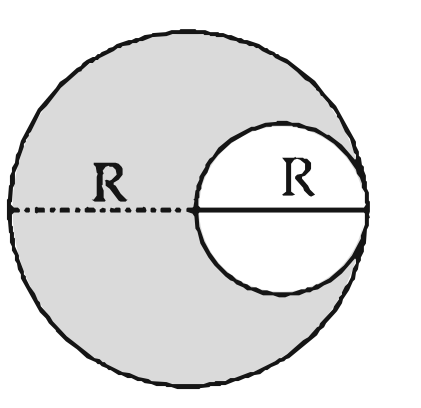
A uniform circular disc of radius 'R' and mass 'M' is rotating about an axis perpendicular to its plane and passing through its centre. A small circular part of radius $R/2$ is removed from the original disc as shown in the figure. Find the moment of inertia of the remaining part of the original disc about the axis as given above.
(1)$\frac{7}{32}MR^2$
(2)$\frac{9}{32}MR^2$
(3)$\frac{17}{32}MR^2$
(4)$\frac{13}{32}MR^2$
Show answer and solution
Correct answer: (4)
Topic: Moment of Inertia of Continuous Bodies, Moment of Inertia
From the original diagram, the removed circular hole of radius $R/2$ is internally tangent to the outer rim. Thus its centre lies a distance $d=R-R/2=R/2$ from the original disc's centre. The sheet has uniform areal mass density, so the removed mass scales with its area:
$$m=M\frac{\pi(R/2)^2}{\pi R^2}=\frac M4.$$
The original full disc has moment of inertia about the specified central perpendicular axis
$$I_{\rm full}=\frac12 MR^2.$$
The removed smaller disc has moment of inertia about its own centre $I_{\rm cm}=\frac12 m(R/2)^2=\frac{MR^2}{32}$. By the parallel-axis theorem, its moment about the **original** centre is
$$I_{\rm removed}=I_{\rm cm}+md^2=\frac{MR^2}{32}+\frac M4\left(\frac R2\right)^2=\frac{3MR^2}{32}.$$
Subtract the missing material:
$$I_{\rm remaining}=I_{\rm full}-I_{\rm removed}=\left(\frac{16}{32}-\frac3{32}\right)MR^2=\boxed{\frac{13}{32}MR^2}.$$
This is printed option **(4)**. The other three coefficients do not follow from the pictured hole position.
Q29Thermal PropertiesSingle correct
An amount of ice of mass $10^{-3}\,\mathrm{kg}$ and temperature $-10^{\circ}\mathrm{C}$ is transformed to vapour of temperature $110^{\circ}\mathrm{C}$ by applying heat. The total amount of work required for this conversion is, (Take, specific heat of ice $=2100\,\mathrm{J\,kg^{-1}\,K^{-1}}$, specific heat of water $=4180\,\mathrm{J\,kg^{-1}\,K^{-1}}$, specific heat of steam $=1920\,\mathrm{J\,kg^{-1}\,K^{-1}}$, Latent heat of ice $=3.35\times10^5\,\mathrm{J\,kg^{-1}}$ and Latent heat of steam $=2.25\times10^6\,\mathrm{J\,kg^{-1}}$)
(1)3043 J
(2)3024 J
(3)3003 J
(4)3022 J
Show answer and solution
Correct answer: (1)
Topic: Latent Heat, Change of State
The question describes **heat being applied**, so “work required” is understood as the total thermal energy supplied to take the $10^{-3}\,\mathrm{kg}$ of ice at $-10^\circ\mathrm C$ to steam at $110^\circ\mathrm C$. There are five consecutive stages: warming ice by $10\,\mathrm K$, melting at $0^\circ\mathrm C$, warming water by $100\,\mathrm K$, vaporizing at $100^\circ\mathrm C$, and warming the steam by $10\,\mathrm K$. Therefore
$$\begin{aligned}
Q={}&m c_{\rm ice}(10)+mL_{\rm ice}+mc_{\rm water}(100)+mL_{\rm steam}+mc_{\rm steam}(10)\\
={}&10^{-3}\bigl[2100(10)+3.35\times10^5+4180(100)\\
&\hspace{55pt}+2.25\times10^6+1920(10)\bigr]\,\mathrm J.
\end{aligned}$$
The stage-by-stage contributions are
$$Q_1=21\,\mathrm J,\quad Q_2=335\,\mathrm J,\quad Q_3=418\,\mathrm J,\quad Q_4=2250\,\mathrm J,\quad Q_5=19.2\,\mathrm J.$$
Adding them gives
$$Q=21+335+418+2250+19.2=3043.2\,\mathrm J\approx\boxed{3043\,\mathrm J}.$$
Option **(1)** is the only listed value agreeing to the nearest joule. This is an energy balance for the supplied heat, not a computation of pressure–volume work.
Q30AtomsSingle correct
An electron in the ground state of the hydrogen atom has the orbital radius of $5.3\times10^{-11}\,\mathrm{m}$ while that for the electron in third excited state is $8.48\times10^{-10}\,\mathrm{m}$. The ratio of the de Broglie wavelengths of electron in the excited state to that in the ground state is
(1)3
(2)16
(3)9
(4)4
Show answer and solution
Correct answer: (4)
Topic: Radius of Bohr Orbits, Bohr Model of Hydrogen Atom
In the Bohr model of hydrogen, the $n$th orbit has radius $r_n=n^2r_1$ and the electron obeys the angular-momentum/de Broglie standing-wave condition
$$2\pi r_n=n\lambda_n.$$
The ground state has $n=1$; the **third excited state** has $n=4$. The supplied radii confirm this identification:
$$\frac{r_4}{r_1}=\frac{8.48\times10^{-10}}{5.3\times10^{-11}}=16=4^2.$$
Therefore
$$\frac{\lambda_4}{\lambda_1}=\frac{2\pi r_4/4}{2\pi r_1/1}=\frac{r_4}{4r_1}=\frac{16}{4}=\boxed{4}.$$
The dimensionless ratio 4 is printed option **(4)**.
Q31Work Energy PowerSingle correct
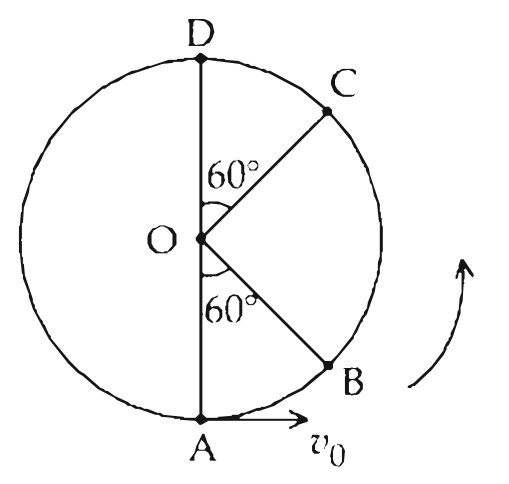
A bob of mass $m$ is suspended at a point $O$ by a light string of length $l$ and left to perform vertical motion (circular) as shown in figure. Initially, by applying horizontal velocity $v_0$ at the point ' A ', the string becomes slack when, the bob reaches at the point ' D '. The ratio of the kinetic energy of the bob at the points $B$ and $C$ is ______ -.
(1)1
(2)2
(3)4
(4)3
Show answer and solution
Correct answer: (2)
Topic: Tension and Radial Force, Vertical Circular Motion Using Energy
At the highest point $D$ the string has just gone slack. The tension therefore vanishes, and gravity alone supplies the centripetal force:
$$mg=\frac{mv_D^2}{l}\quad\Longrightarrow\quad v_D^2=gl.$$
In the figure, the radius $OB$ makes $60^\circ$ with the downward vertical, and $OC$ makes $60^\circ$ with the upward vertical. Measured vertically from the centre $O$, their heights are
$$h_B=-l\cos60^\circ=-\frac l2,\qquad h_C=l\cos60^\circ=\frac l2,\qquad h_D=l.$$
Conservation of mechanical energy from either point to $D$ gives
$$\frac12mv_B^2+mg\left(-\frac l2\right)=\frac12mgl+mgl\quad\Longrightarrow\quad v_B^2=4gl,$$
$$\frac12mv_C^2+mg\left(\frac l2\right)=\frac12mgl+mgl\quad\Longrightarrow\quad v_C^2=2gl.$$
The masses cancel in the kinetic-energy ratio:
$$\boxed{\frac{K_B}{K_C}=\frac{v_B^2}{v_C^2}=\frac{4gl}{2gl}=2}.$$
The ratio is dimensionless, and it appears only in option **(2)**.
Q32Ray Optics and Optical InstrumentsSingle correct
Given is a thin convex lens of glass (refractive index $\mu$) and each side having radius of curvature $R$. One side is polished for complete reflection. At what distance from the lens, an object be placed on the optic axis so that the image gets formed on the object itself ?
(1)$\frac{R}{\mu}$
(2)$\frac{R}{2\mu-3}$
(3)$\mu R$
(4)$\frac{R}{2\mu-1}$
Show answer and solution
Correct answer: (4)
Topic: Lens Maker Formula, Thin Lenses
For the thin symmetrical double-convex glass lens, the lens-maker formula in air gives
$$\frac1{f_L}=(\mu-1)\left(\frac1R-\frac1{-R}\right)=\frac{2(\mu-1)}R.$$
After one passage through the lens the ray is reflected by its polished curved surface and makes a return passage. In the thin-element, paraxial approximation, the combined reflecting power can be written as the power from two lens traversals plus the spherical-reflector power:
$$P_{\mathrm{eq}}=\frac2{f_L}+\frac2R=\frac{4(\mu-1)+2}{R}=\frac{2(2\mu-1)}R.$$
Thus the equivalent reflecting system has focal distance
$$f_{\mathrm{eq}}=\frac1{P_{\mathrm{eq}}}=\frac{R}{2(2\mu-1)}.$$
For the object and its returned image to coincide, it must occupy the self-conjugate position of the equivalent spherical mirror, at twice the focal distance:
$$\boxed{u=2f_{\mathrm{eq}}=\frac{R}{2\mu-1}}.$$
This has units of length and selects option **(4)**. The other expressions do not give the mirror's self-conjugate position.
Q33Semiconductor Electronics: Materials, Devices and Simple CircuitsSingle correct
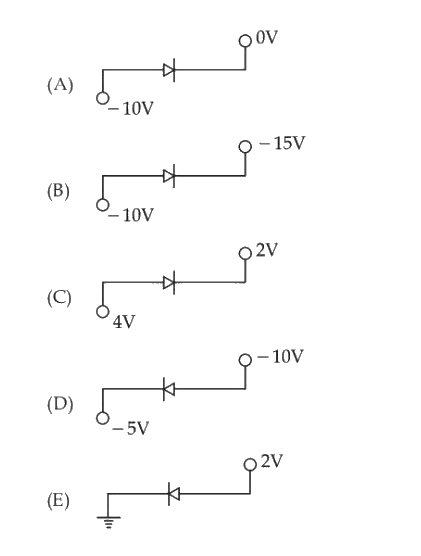
Which of the following circuits represents a forward biased diode? Choose the correct answer from the options given below :
(1)(A) and (D) only
(2)(B), (D) and (E) only
(3)(C) and (E) only
(4)(B), (C) and (E) only
Show answer and solution
Correct answer: (4)
Topic: Forward Bias, Semiconductor Diode
Forward bias requires the potential of a diode's anode (non-bar end) to exceed that of its cathode (bar end):
$$V_{\mathrm{anode}}-V_{\mathrm{cathode}}>0.$$
Reading each of the five circuits exactly as drawn:
- **A:** anode $-10\,\mathrm V$, cathode $0\,\mathrm V$; difference $-10\,\mathrm V$, hence reverse bias.
- **B:** anode $-10\,\mathrm V$, cathode $-15\,\mathrm V$; difference $+5\,\mathrm V$, hence forward bias.
- **C:** anode $+4\,\mathrm V$, cathode $+2\,\mathrm V$; difference $+2\,\mathrm V$, hence forward bias.
- **D:** anode $-10\,\mathrm V$ on the right, cathode $-5\,\mathrm V$ on the left; difference $-5\,\mathrm V$, hence reverse bias.
- **E:** anode $+2\,\mathrm V$ on the right, cathode $0\,\mathrm V$ on the grounded left; difference $+2\,\mathrm V$, hence forward bias.
Therefore precisely $\boxed{\mathrm{B,C,E}}$ are forward biased. This is option **(4)**; every other option either includes A or D or fails to include a forward-biased circuit.
Q34Current ElectricitySingle correct
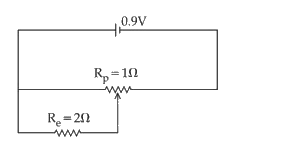
Sliding contact of a potentiometer is in the middle of the potentiometer wire having resistance $R_p=1\Omega$ as shown in the figure. An external resistance of $R_e=2\Omega$ is connected via the sliding contact. The electric current in the circuit is :
(1)0.9 A
(2)1.35 A
(3)0.3 A
(4)1.0 A
Show answer and solution
Correct answer: (4)
Topic: Loop Rule, Kirchhoff's Rules
The $1\,\Omega$ potentiometer wire is uniform, and the sliding contact is its midpoint. Thus the two half-wire resistances are
$$R_1=R_2=\frac{1\,\Omega}{2}=0.5\,\Omega.$$
As the circuit drawing shows, the $2\,\Omega$ external resistor runs from the left endpoint to the slider, so it is in parallel with the left half, not with the entire potentiometer. The equivalent of those two parallel branches is
$$R_{\parallel}=\frac{(2)(0.5)}{2+0.5}\,\Omega=0.4\,\Omega.$$
This is in series with the right $0.5\,\Omega$ half:
$$R_{\mathrm{eq}}=0.4+0.5=0.9\,\Omega.$$
The supplied emf is $0.9\,\mathrm V$, and no internal resistance is specified. Hence
$$\boxed{I=\frac{0.9\,\mathrm V}{0.9\,\Omega}=1.0\,\mathrm A}.$$
Option **(4)** alone gives the circuit's total current.
Q35GravitationSingle correct
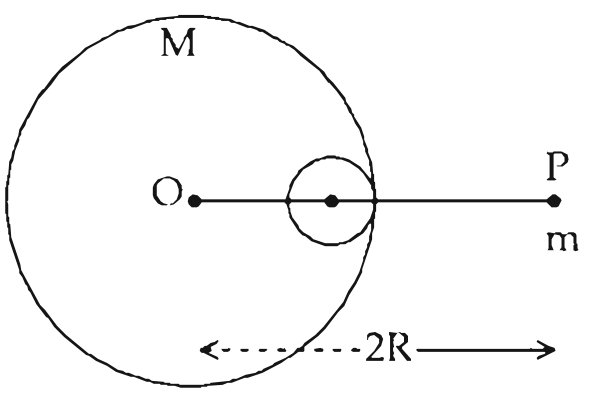
A small point of mass $m$ is placed at a distance $2R$ from the centre 'O' of a big uniform solid sphere of mass $M$ and radius $R$. The gravitational force on 'm' due to $M$ is $F_1$. A spherical part of radius $R/3$ is removed from the big sphere as shown in the figure and the gravitational force on m due to remaining part of $M$ is found to be $F_2$. The value of ratio $F_1:F_2$ is
(1)12 : 11
(2)11 : 10
(3)12 : 9
(4)16 : 9
Show answer and solution
Correct answer: (1)
Topic: Superposition of Gravitational Forces, Universal Gravitation and Superposition
A uniform spherical body attracts an external point mass as if all its mass were at its centre. Before the cavity is made, the mass $m$ is $2R$ from $O$, so
$$F_1=\frac{GMm}{(2R)^2}=\frac{GMm}{4R^2}.$$
The cavity has radius $R/3$ and, because the density is the same everywhere, would contain mass
$$M_c=M\left(\frac{R/3}{R}\right)^3=\frac M{27}.$$
The picture places its centre $2R/3$ to the right of $O$, toward $m$. The distance between $m$ and the cavity centre is therefore $2R-2R/3=4R/3$. Were that removed mass present, its attraction would be
$$F_c=\frac{G(M/27)m}{(4R/3)^2}=\frac{GMm}{48R^2}=\frac{F_1}{12}.$$
The forces lie on the same line, and gravitational attraction is additive. Removing the cavity mass leaves
$$F_2=F_1-F_c=\frac{11F_1}{12}.$$
Consequently
$$\boxed{F_1:F_2=12:11},$$
which is option **(1)**.
Q36WavesSingle correct
A closed organ and an open organ tube are filled by two different gases having same bulk modulus but different densities $\rho_1$ and $\rho_2^{\prime}$, respectively. The frequency of $9^{\mathrm{th}}$ harmonic of closed tube is identical with $4^{\mathrm{th}}$ harmonic of open tube. If the length of the closed tube is 10 cm and the density ratio of the gases is $\rho_1:\rho_2=1:16$, then the length of the open tube is :
(1)$\frac{15}{7}\,\mathrm{cm}$
(2)$\frac{20}{7}\,\mathrm{cm}$
(3)$\frac{15}{9}\,\mathrm{cm}$
(4)$\frac{20}{9}\,\mathrm{cm}$
Show answer and solution
Correct answer: (4)
Topic: Closed Organ Pipe, Standing Sound Waves in Air Columns
Write $L_c=10\,\mathrm{cm}$ and $L_o$ for the lengths of the closed and open pipes. Denote the gas densities consistently by $\rho_1$ and $\rho_2$, with $\rho_1:\rho_2=1:16$. Their bulk modulus $B$ is the same, and the wave speed in each is $v=\sqrt{B/\rho}$. Hence
$$\frac{v_1}{v_2}=\sqrt{\frac{\rho_2}{\rho_1}}=\sqrt{16}=4.$$
For an ideal pipe closed at one end, the ninth harmonic has frequency $9v_1/(4L_c)$. For an ideal open pipe, the fourth harmonic has frequency $4v_2/(2L_o)$. Equating them gives
$$\frac{9v_1}{4L_c}=\frac{4v_2}{2L_o}\quad\Longrightarrow\quad L_o=\frac{8v_2L_c}{9v_1}.$$
Substitution yields
$$\boxed{L_o=\frac8{9}\left(\frac14\right)(10\,\mathrm{cm})=\frac{20}{9}\,\mathrm{cm}}.$$
The result is a length, equal to the value in option **(4)**.
Q37Units & MeasurementsSingle correct
If $B$ is magnetic field and $\mu_0$ is permeability of free space, then the dimensions of $(B/\mu_0)$ is
(1)$ML^{2}T^{-2}A^{-1}$
(2)$MT^{-2}A^{-1}$
(3)$L^{-1}A$
(4)$LT^{-2}A^{-1}$
Show answer and solution
Correct answer: (3)
Topic: Dimensional Formula, Dimensional Formulae and Equations
Using the magnetic force $F=BIL$ on a straight conductor perpendicular to the field, the magnetic-field dimensions are
$$[B]=\frac{[F]}{[I][L]}=\frac{MLT^{-2}}{AL}=MT^{-2}A^{-1}.$$
From the force per unit length on two parallel current-carrying wires,
$$\frac FL=\frac{\mu_0I_1I_2}{2\pi d},$$
we obtain
$$[\mu_0]=\frac{[F/L][d]}{A^2}=\frac{(MT^{-2})(L)}{A^2}=MLT^{-2}A^{-2}.$$
Dividing the dimensions gives
$$\boxed{\left[\frac B{\mu_0}\right]=\frac{MT^{-2}A^{-1}}{MLT^{-2}A^{-2}}=L^{-1}A}.$$
This is option **(3)**; the remaining options retain incorrect dimensions of mass or time.
Q38Electric Charges and FieldsSingle correct
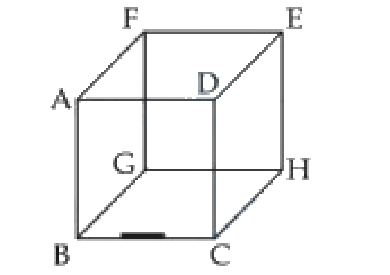
A line charge of length $\frac{\text{'a'}}{2}$ is kept at the center of an edge $BC$ of a cube $ABCDEFGH$ having edge length 'a' as shown in the figure. If the density of line charge is $\lambda$ C per unit length, then the total electric flux through all the faces of the cube will be ______ . (Take, $\epsilon_0$ as the free space permittivity)
(1)$\frac{\lambda a}{2\epsilon_0}$
(2)$\frac{\lambda a}{4\epsilon_0}$
(3)$\frac{\lambda a}{16\epsilon_0}$
(4)$\frac{\lambda a}{8\epsilon_0}$
Show answer and solution
Correct answer: (4)
Topic: Applications of Gauss's Law, Gauss's Law
The line charge is a length $a/2$ centered on edge $BC$ of the cube. Its charge is
$$q=\lambda\frac a2.$$
To account correctly for a line charge lying on a Gaussian-surface edge, imagine joining four identical cubes symmetrically around that edge. The line charge then lies inside their union and is shared equally among the four cubes. The external flux of the combined symmetric construction is, by Gauss's law,
$$\Phi_{\mathrm{combined}}=\frac q{\epsilon_0}=\frac{\lambda a}{2\epsilon_0}.$$
A quarter-turn around the edge maps each of the four cubes to another, so their contributions to the outward flux are equal. Therefore the flux through all faces of one original cube is
$$\boxed{\Phi_{\mathrm{cube}}=\frac14\Phi_{\mathrm{combined}}=\frac{\lambda a}{8\epsilon_0}}.$$
Its dimensions are those of electric flux, $\mathrm{N\,m^2/C}$, and it matches option **(4)**.
Q39Units & MeasurementsSingle correct
Given below are two statements : Statement I : In a vernier callipers, one vernier scale division is always smaller than one main scale division. Statement II : The vernier constant is given by one main scale division multiplied by the number of vernier scale divisions. In the light of the above statements, choose the correct answer from the options given below.
(1)Statement I is true but Statement II is false
(2)Statement I is false but Statement II is true
(3)Both Statement I and Statement II are false
(4)Both Statement I and Statement II are true
Show answer and solution
Correct answer: (3)
Topic: Precision and Least Count, Reliable and Uncertain Digits
**Statement I is false.** In the common *direct* vernier, a vernier division is slightly smaller than one main-scale division, but that is not universally true. A reverse (retrograde) vernier may use vernier divisions that are larger. Hence the word “always” makes Statement I false.
**Statement II is also false.** A vernier constant or least count is the difference in size of the two divisions:
$$\mathrm{LC}=|1\,\mathrm{MSD}-1\,\mathrm{VSD}|.$$
For instance, for a conventional direct vernier with $N$ vernier divisions occupying $(N-1)$ main-scale divisions,
$$1\,\mathrm{VSD}=\frac{N-1}{N}(1\,\mathrm{MSD}),\qquad \mathrm{LC}=\frac{1\,\mathrm{MSD}}N.$$
Thus the main-scale division is **divided**, not multiplied, by $N$. Both assertions are false, making $\boxed{\text{option (3)}}$ correct.
Q40Dual Nature of Radiation and MatterSingle correct
The work functions of cesium (Cs) and lithium (Li) metals are 1.9 eV and 2.5 eV, respectively. If we incident a light of wavelength 550 nm on these two metal surfaces, then photo-electric effect is possible for the case of
For incident light of wavelength $550\,\mathrm{nm}$, the photon energy is
$$E_\gamma=\frac{hc}{\lambda}\simeq\frac{1240\,\mathrm{eV\,nm}}{550\,\mathrm{nm}}=2.2545\,\mathrm{eV}.$$
Photoemission is possible if the photon energy is at least the metal's work function. For Cs,
$$E_\gamma-\phi_{\mathrm{Cs}}=2.2545-1.9\simeq0.3545\,\mathrm{eV}>0,$$
so Cs emits photoelectrons. For Li,
$$E_\gamma-\phi_{\mathrm{Li}}=2.2545-2.5\simeq-0.2455\,\mathrm{eV}<0,$$
so Li does not. It follows that photoelectric effect occurs for $\boxed{\text{Cs only}}$, option **(3)**. The 'both', 'neither' and 'Li only' options contradict these threshold inequalities.
Q41Thermal PropertiesSingle correct
Two spherical bodies of same materials having radii $0.2\,\mathrm{m}$ and $0.8\,\mathrm{m}$ are placed in same atmosphere. The temperature of the smaller body is $800\,\mathrm{K}$ and temperature of the bigger body is $400\,\mathrm{K}$. If the energy radiated from the smaller body is $E$, the energy radiated from the bigger body is (assume, effect of the surrounding temperature to be negligible),
(1)$16E$
(2)$E$
(3)$64E$
(4)$256E$
Show answer and solution
Correct answer: (2)
Topic: Thermal Radiation, Heat Transfer
In equal time intervals, with identical emissivities and negligible surroundings, the Stefan–Boltzmann law states
$$E_{\mathrm{radiated}}\propto \varepsilon\sigma (4\pi r^2)T^4\propto r^2T^4.$$
The larger sphere's radius is $0.8/0.2=4$ times the smaller sphere's radius, but its absolute temperature is $400/800=1/2$ times as great. Thus
$$\frac{E_{\mathrm{large}}}{E_{\mathrm{small}}}=\left(\frac{0.8}{0.2}\right)^2\left(\frac{400}{800}\right)^4=4^2\left(\frac12\right)^4=16\cdot\frac1{16}=1.$$
The surface-area factor and temperature factor exactly cancel, so for $E_{\mathrm{small}}=E$,
$$\boxed{E_{\mathrm{large}}=E}.$$
Only option **(2)** gives this result.
Q42Ray Optics and Optical InstrumentsSingle correct
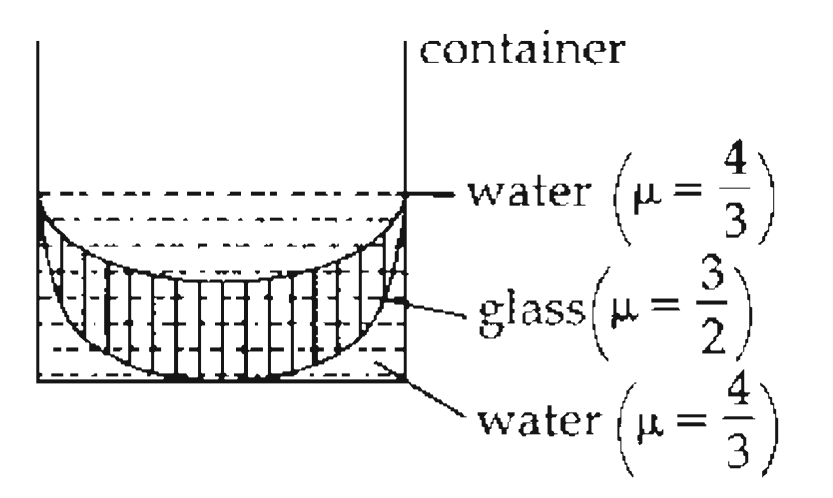
In the diagram given below, there are three lenses formed. Considering negligible thickness of each of them as compared to $|R_1|$ and $|R_2|$, i.e., the radii of curvature for upper and lower surfaces of the glass lens, the power of the combination is
$$\begin{gathered}\text{container}\\\text{water }(\mu=\frac{4}{3})\\\text{glass }(\mu=\frac{3}{2})\\\text{water }(\mu=\frac{4}{3})\end{gathered}$$
The upper and lower horizontal air–water boundaries in the drawing have infinite radius and hence zero refracting power. Only the two curved interfaces between water and the thin glass lens matter. The refractive indices are
$$n_g=\frac32,\qquad n_w=\frac43,\qquad n_g-n_w=\frac16.$$
Take the light to travel downward through the three layers. Both drawn interfaces are curved like an upward-opening bowl, so their centres of curvature lie on the incident side; their signed radii are $R_1=-|R_1|$ and $R_2=-|R_2|$.
With negligible layer thickness the interface powers add:
$$P=\frac{n_g-n_w}{R_1}+\frac{n_w-n_g}{R_2}=\frac16\left(\frac1{R_1}-\frac1{R_2}\right).$$
Using these signed radii,
$$\boxed{P=-\frac16\left(\frac1{|R_1|}-\frac1{|R_2|}\right)}.$$
For radii expressed in metres, $P$ is in dioptres, $\mathrm m^{-1}$. The correct sign and the difference of reciprocal radii occur in option **(4)**.
Q43Wave OpticsSingle correct
Given below are two statements : one is labelled as Assertion (A) and the other is labelled as Reason (R).
Assertion-(A) : If Young's double slit experiment is performed in an optically denser medium than air, then the consecutive fringes come closer.
Reason-(R) : The speed of light reduces in an optically denser medium than air while its frequency does not change.
In the light of the above statements, choose the most appropriate answer from the options given below :
(1)Both (A) and (R) are true but (R) is not the correct explanation of (A)
(2)Both (A) and (R) are true and (R) is the correct explanation of (A)
(3)(A) is true but (R) is false
(4)(A) is false but (R) is true
Show answer and solution
Correct answer: (2)
Topic: Young's Double-Slit Experiment, Interference of Light
Young's double-slit fringe spacing is
$$\beta=\frac{\lambda D}{d},$$
where $d$ is slit separation, $D$ is the distance to the screen and $\lambda$ is the wavelength in the medium. Moving the arrangement from air to an optically denser transparent medium reduces the light speed to $v=c/n$, but its frequency $f$ stays the same. Therefore
$$\lambda_{\mathrm{medium}}=\frac vf=\frac{c}{nf}=\frac{\lambda_{\mathrm{air}}}{n}.$$
The new fringe width is
$$\beta_{\mathrm{medium}}=\frac{\lambda_{\mathrm{air}}D}{nd}=\frac{\beta_{\mathrm{air}}}{n}<\beta_{\mathrm{air}}\quad(n>1).$$
Thus the fringes do come closer: Assertion (A) is true. Reason (R) is also true, and the resulting smaller wavelength is precisely why (A) holds. Consequently $\boxed{\text{both are true and R explains A}}$, option **(2)**.
Q44Electrostatic Potential and CapacitanceSingle correct
A parallel-plate capacitor of capacitance $40\,\mu\mathrm{F}$ is connected to a $100\,\mathrm{V}$ power supply. Now the intermediate space between the plates is filled with a dielectric material of dielectric constant $K=2$. Due to the introduction of dielectric material, the extra charge and the change in the electrostatic energy in the capacitor, respectively, are
(1)$4\,\mathrm{mC}$ and $0.2\,\mathrm{J}$
(2)$8\,\mathrm{mC}$ and $2.0\,\mathrm{J}$
(3)$2\,\mathrm{mC}$ and $0.4\,\mathrm{J}$
(4)$2\,\mathrm{mC}$ and $0.2\,\mathrm{J}$
Show answer and solution
Correct answer: (1)
Topic: Effect of Dielectric, Capacitance
The capacitor remains connected to the $100\,\mathrm V$ supply, so its voltage stays constant as the dielectric is inserted. Initially
$$C_i=40\,\mu\mathrm F.$$
With the plates fully filled by dielectric $K=2$,
$$C_f=KC_i=2(40)=80\,\mu\mathrm F.$$
The extra charge supplied by the battery is
$$\Delta Q=(C_f-C_i)V=(40\times10^{-6}\,\mathrm F)(100\,\mathrm V)=4\times10^{-3}\,\mathrm C=\boxed{4\,\mathrm{mC}}.$$
The stored electrostatic energy is $U=\tfrac12CV^2$. Its change is
$$\Delta U=\frac12(C_f-C_i)V^2=\frac12(40\times10^{-6})(100)^2\,\mathrm J=\boxed{0.2\,\mathrm J}.$$
Both values increase at fixed supply voltage. Their ordered pair is $\boxed{(4\,\mathrm{mC},\ 0.2\,\mathrm J)}$, which appears only in option **(1)**.
Q45Current ElectricitySingle correct
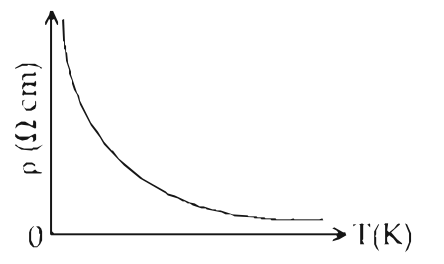
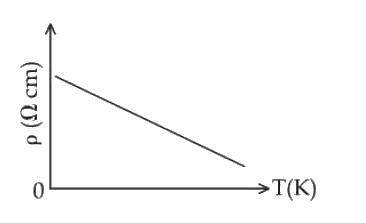
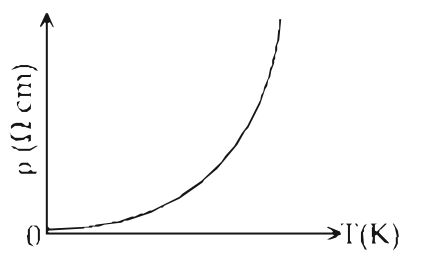
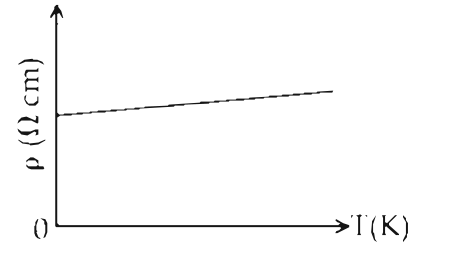
Which of the following resistivity ($\rho$) v/s temperature (T) curves is most suitable to be used in wire bound standard resistors?
(1)(1)
(2)(2)
(3)(3)
(4)(4)
Show answer and solution
Correct answer: (4)
Topic: Temperature Dependence of Resistance
A wire-wound standard resistor is intended to retain a stable resistance when the temperature varies. For wire dimensions that are nearly unchanged,
$$R=\rho\frac LA.$$
A stable resistor requires a very small temperature coefficient of resistivity:
$$\alpha=\frac1\rho\frac{d\rho}{dT}\simeq0.$$
Inspecting the four $\rho$-versus-$T$ plots, curve **(1)** falls strongly and nonlinearly, **(2)** falls substantially with a negative slope, **(3)** rises rapidly with a large positive slope, and **(4)** is nearly horizontal with only a slight variation. Curve **(4)** has the smallest magnitude of $d\rho/dT$ and is therefore suitable for a wire-wound standard resistance, such as one made using a low-temperature-coefficient alloy. Thus the answer is $\boxed{\text{option (4)}}$.
Q46Ray Optics and Optical InstrumentsNumerical
The driver sitting inside a parked car is watching vehicles approaching from behind with the help of his side view mirror, which is a convex mirror with radius of curvature $R=2\,\mathrm{m}$. Another car approaches him from behind with a uniform speed of $90\,\mathrm{km/hr}$. When the car is at a distance of $24\,\mathrm{m}$ from him, the magnitude of the acceleration of the image of the car in the side view mirror is 'a'. The value of $100\,a$ is _______ $\mathrm{m/s^2}$.
Show answer and solution
Correct answer: 8
Topic: Spherical Mirrors, Reflection of Light
A convex mirror has virtual focal length $f=R/2=1\,\mathrm m$. Let $x>0$ be the car's distance in front of the mirror and $y>0$ its image distance behind the mirror. With the mirror sign convention $u=-x$, $v=+y$, the mirror equation is
$$\frac1f=\frac1v+\frac1u=\frac1y-\frac1x.$$
Solving for the image location,
$$y=\frac{fx}{x+f}.$$
The car approaches at constant velocity $90\,\mathrm{km\,h^{-1}}=25\,\mathrm{m\,s^{-1}}$, so $\dot x=-25\,\mathrm{m\,s^{-1}}$ and $\ddot x=0$. Differentiating with respect to time,
$$\dot y=\frac{f^2\dot x}{(x+f)^2},\qquad \ddot y=\frac{f^2\ddot x}{(x+f)^2}-\frac{2f^2\dot x^{\,2}}{(x+f)^3}=-\frac{2f^2\dot x^{\,2}}{(x+f)^3}.$$
At $x=24\,\mathrm m$, the acceleration magnitude is
$$a=\frac{2(1\,\mathrm m)^2(25\,\mathrm{m\,s^{-1}})^2}{(25\,\mathrm m)^3}=\frac{1250}{15625}\,\mathrm{m\,s^{-2}}=0.08\,\mathrm{m\,s^{-2}}.$$
Hence $\boxed{100a=8\,\mathrm{m\,s^{-2}}}$ and the numerical answer is **8**. The negative second derivative refers to the signed image coordinate; the question asks for its magnitude.
Q47FluidsNumerical
Two soap bubbles of radius $2\,\mathrm{cm}$ and $4\,\mathrm{cm}$, respectively, are in contact with each other. The radius of curvature of the common surface, in $\mathrm{cm}$, is ______ .
Show answer and solution
Correct answer: 4
Topic: Excess Pressure Across Curved Surfaces, Surface Tension
For a spherical soap bubble, which has two surfaces, the excess pressure is $4T/r$. Assume the two bubbles have the same surface tension $T$, and let $P_0$ denote atmospheric pressure. Their internal pressures are
$$P_1=P_0+\frac{4T}{2\,\mathrm{cm}},\qquad P_2=P_0+\frac{4T}{4\,\mathrm{cm}}.$$
The smaller bubble has the greater internal pressure, so the curved common soap film sustains a pressure difference $P_1-P_2=4T/R_c$, where $R_c$ is its radius of curvature. Therefore
$$\frac{4T}{R_c}=P_1-P_2=4T\left(\frac1{2\,\mathrm{cm}}-\frac1{4\,\mathrm{cm}}\right).$$
Cancel $4T$ to obtain
$$\frac1{R_c}=\frac14\,\mathrm{cm^{-1}}\quad\Longrightarrow\quad\boxed{R_c=4\,\mathrm{cm}}.$$
The requested numerical entry is **4**.
Q48Rotation & SystemNumerical
The position vectors of two $1\,\mathrm{kg}$ particles, (A) and (B), are given by $\vec{r}_A=(\alpha_1t^2\hat{i}+\alpha_2t\hat{j}+\alpha_3t\hat{k})\,\mathrm{m}$ and $\vec{r}_B=(\beta_1t\hat{i}+\beta_2t^2\hat{j}+\beta_3t\hat{k})\,\mathrm{m}$, respectively;
$(\alpha_1=1\,\mathrm{m/s^2},\alpha_2=3n\,\mathrm{m/s},\alpha_3=2\,\mathrm{m/s},\beta_1=2\,\mathrm{m/s},\beta_2=-1\,\mathrm{m/s^2},\beta_3=4p\,\mathrm{m/s})$, where $t$ is time, $n$ and $p$ are constants. At $t=1\,\mathrm{s}$, $|\vec{V}_A|=|\vec{V}_B|$ and velocities $\vec{V}_A$ and $\vec{V}_B$ of the particles are orthogonal to each other.
At $t=1\,\mathrm{s}$, the magnitude of angular momentum of particle (A) with respect to the position of particle (B) is $\sqrt{L}\,\mathrm{kg\,m^2\,s^{-1}}$. The value of $L$ is _______ .
Show answer and solution
Correct answer: 90
Topic: Angular Momentum of a Particle, Angular Momentum
Express time $t$ numerically in seconds and all position components in metres. Substituting the given constants,
$$\vec r_A=(t^2\hat i+3nt\hat j+2t\hat k)\,\mathrm m,\qquad \vec r_B=(2t\hat i-t^2\hat j+4pt\hat k)\,\mathrm m.$$
Taking time derivatives and setting $t=1\,\mathrm s$,
$$\vec v_A=(2,3n,2)\,\mathrm{m\,s^{-1}},\qquad \vec v_B=(2,-2,4p)\,\mathrm{m\,s^{-1}}.$$
Equal speed magnitudes give
$$2^2+(3n)^2+2^2=2^2+(-2)^2+(4p)^2\quad\Rightarrow\quad 9n^2=16p^2.$$
The perpendicular-velocity condition is
$$\vec v_A\cdot\vec v_B=4-6n+8p=0\quad\Rightarrow\quad 3n=2+4p.$$
Because $3n=\pm4p$, the positive branch would give $4p=2+4p$, an impossibility. Thus $3n=-4p=2+4p$, whence $p=-\tfrac14$ and $n=\tfrac13$.
At $t=1\,\mathrm s$,
$$\vec r_A=(1,1,2)\,\mathrm m,\quad \vec r_B=(2,-1,-1)\,\mathrm m,\quad\vec v_A=(2,1,2)\,\mathrm{m\,s^{-1}}.$$
For angular momentum of A about B's **instantaneous position**, use A's linear momentum $m_A\vec v_A$ and the position vector $\vec r_A-\vec r_B$:
$$\vec r_{A/B}=(-1,2,3)\,\mathrm m,\qquad\vec L_{A/B}=\vec r_{A/B}\times m_A\vec v_A.$$
With $m_A=1\,\mathrm{kg}$,
$$\vec L_{A/B}=\begin{vmatrix}\hat i&\hat j&\hat k\\-1&2&3\\2&1&2\end{vmatrix}=(1,8,-5)\,\mathrm{kg\,m^2\,s^{-1}}.$$
Hence $|\vec L_{A/B}|=\sqrt{1^2+8^2+(-5)^2}=\sqrt{90}\,\mathrm{kg\,m^2\,s^{-1}}$, which means $\boxed{L=90}$.
Q49Thermal PropertiesNumerical
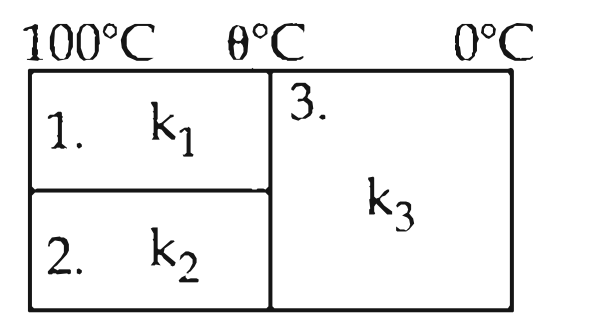
Three conductors of same length having thermal conductivity $k_1$, $k_2$ and $k_3$ are connected as shown in figure.
$$\begin{array}{ccc}100^\circ\mathrm{C}&\theta^\circ\mathrm{C}&0^\circ\mathrm{C}\\\text{1.}\ k_1&&\text{3.}\ k_3\\\text{2.}\ k_2&&\end{array}$$
Area of cross sections of $1^{\mathrm{st}}$ and $2^{\mathrm{nd}}$ conductor are same and for $3^{\mathrm{rd}}$ conductor it is double of the $1^{\mathrm{st}}$ conductor. The temperatures are given in the figure. In steady state condition, the value of $\theta$ is _______ $^\circ\mathrm{C}$. (Given : $k_1=60\,\mathrm{J\,s^{-1}\,m^{-1}\,K^{-1}}$, $k_2=120\,\mathrm{J\,s^{-1}\,m^{-1}\,K^{-1}}$, $k_3=135\,\mathrm{J\,s^{-1}\,m^{-1}\,K^{-1}}$)
Show answer and solution
Correct answer: 40
Topic: Conduction, Heat Transfer
From the circuit-like thermal arrangement in the figure, conductors 1 and 2 connect the $100^\circ\mathrm C$ end to the common junction at $\theta^\circ\mathrm C$ **in parallel**; conductor 3 then carries the total heat flow from that junction to the $0^\circ\mathrm C$ end. All lengths are $\ell$. Let $A_1=A_2=A$ and $A_3=2A$.
The steady heat-current magnitude through a conductor is $\dot Q=kA\Delta T/\ell$. At the junction, energy conservation requires
$$\frac{k_1A}{\ell}(100-\theta)+\frac{k_2A}{\ell}(100-\theta)=\frac{k_3(2A)}{\ell}\theta.$$
The $A/\ell$ factors cancel; the numerical temperature differences can be taken in kelvins or degrees Celsius:
$$(60+120)(100-\theta)=2(135)\theta.$$
Therefore $18000-180\theta=270\theta$, so $450\theta=18000$ and
$$\boxed{\theta=40^\circ\mathrm C}.$$
The conductivity units $\mathrm{J\,s^{-1}\,m^{-1}\,K^{-1}}$ produce a heat flow in $\mathrm{J\,s^{-1}}$ on each side of the balance.
Q50Motion in a PlaneNumerical
A particle is projected at an angle of $30^\circ$ from horizontal at a speed of $60\,\mathrm{m/s}$. The height traversed by the particle in the first second is $h_0$ and height traversed in the last second, before it reaches the maximum height, is $h_1$. The ratio $h_0:h_1$ is _________ [Take, $g=10\,\mathrm{m/s^2}$]
Show answer and solution
Correct answer: 5
Topic: Projectile Motion
Resolve the initial projectile velocity vertically:
$$u_y=(60\,\mathrm{m\,s^{-1}})\sin30^\circ=30\,\mathrm{m\,s^{-1}}.$$
For upward-positive displacement under $g=10\,\mathrm{m\,s^{-2}}$,
$$y(t)=u_yt-\tfrac12gt^2=30t-5t^2\quad\text{metres},$$
where $t$ is in seconds. The time to maximum height is $t_H=u_y/g=3\,\mathrm s$.
The rise during the first second is
$$h_0=y(1)-y(0)=25-0=25\,\mathrm m.$$
The last second of the ascent is from $t=2\,\mathrm s$ to $t=3\,\mathrm s$, not the last second of the total flight. Its rise is
$$h_1=y(3)-y(2)=(90-45)-(60-20)=45-40=5\,\mathrm m.$$
Both displacements are upward, so they equal the heights traversed. Thus
$$\boxed{h_0:h_1=25:5=5:1},$$
and the numerical answer is **5**.
Q51AtomsSingle correct
Radius of the first excited state of Helium ion is given as : $a_0\to$ radius of first stationary state of hydrogen atom.
(1)$r=4a_0$
(2)$r=2a_0$
(3)$r=\frac{a_0}{2}$
(4)$r=\frac{a_0}{4}$
Show answer and solution
Correct answer: (2)
Topic: Radius of Bohr Orbits, Bohr Model of Hydrogen Atom
The singly ionized helium atom $\mathrm{He^+}$ contains one electron and a nucleus of charge $+2e$; it is a hydrogen-like system with $Z=2$. Its Bohr radius in state $n$ is
$$r_n=\frac{n^2}{Z}a_0,$$
where $a_0$ is the radius of the hydrogen ground state. The **first excited** orbit has $n=2$, giving
$$r_2=\frac{2^2}{2}a_0=\boxed{2a_0}.$$
Thus **option (2)** is correct. Options (1), (3) and (4), respectively $4a_0$, $a_0/2$, and $a_0/4$, do not give the $n=2$, $Z=2$ result.
Chemistry
Q52Organic Chemistry – Some Basic Principles and TechniquesSingle correct
The incorrect statements regarding geometrical isomerism are : (A) Propene shows geometrical isomerism. (B) Trans isomer has identical atoms/groups on the opposite sides of the double bond. (C) Cis-but-2-ene has higher dipole moment than trans-but-2-ene. (D) 2-methylbut-2-ene shows two geometrical isomers. (E) Trans-isomer has lower melting point than cis isomer. Choose the correct answer from the options given below :
(1)(A) and (E) Only
(2)(A), (D) and (E) Only
(3)(B) and (C) Only
(4)(C), (D) and (E) Only
Show answer and solution
Correct answer: (2)
Topic: Isomerism
Geometrical isomerism at a carbon–carbon double bond requires **two different substituents on each double-bond carbon**. Assess all statements:
- **(A) Incorrect:** propene $\mathrm{CH_3CH=CH_2}$ has two hydrogens on the terminal double-bond carbon, so it has no geometrical isomers.
- **(B) Correct:** in ordinary cis/trans nomenclature, corresponding or identical groups occupy opposite sides in the trans form.
- **(C) Correct:** cis-but-2-ene has a net bond-dipole resultant, whereas the symmetrical trans form has cancellation; hence $\mu_{\mathrm{cis}}>\mu_{\mathrm{trans}}$.
- **(D) Incorrect:** $\mathrm{(CH_3)_2C=CHCH_3}$, 2-methylbut-2-ene, has identical methyl substituents on one double-bond carbon; no pair of geometrical isomers is possible.
- **(E) Incorrect as the general comparison intended:** trans forms of simple disubstituted alkenes are often more symmetrical and pack more efficiently, giving a higher rather than a lower melting point than corresponding cis forms. Individual substances can deviate from such trends.
Consequently the incorrect statements are **A, D, and E**, giving $\boxed{\text{option (2)}}$. Choice (1) omits D; (3) identifies true statements B and C; (4) includes the true statement C while omitting A.
Q53Chemical ThermodynamicsSingle correct
A liquid when kept inside a thermally insulated closed vessel at $25^\circ\mathrm{C}$ was mechanically stirred from outside. What will be the correct option for the following thermodynamic parameters ?
(1)$\Delta U<0,q=0,w>0$
(2)$\Delta U=0,q=0,w=0$
(3)$\Delta U>0,q=0,w>0$
(4)$\Delta U=0,q<0,w>0$
Show answer and solution
Correct answer: (3)
Topic: Internal Energy and First Law
Choose the stirred liquid as the system and use the chemistry first-law convention
$$\Delta U=q+w,$$
where $w>0$ means work is done **on** the system. The vessel is thermally insulated, so it transfers no heat: $q=0$. The externally driven stirrer applies mechanical work to the liquid, giving $w>0$. Thus
$$\Delta U=0+w>0.$$
The work is dissipated into the liquid's internal energy; the stated $25^\circ\mathrm C$ is its initial temperature, not a requirement that the stirring be isothermal. Therefore
$$\boxed{\Delta U>0,\quad q=0,\quad w>0},$$
which is **option (3)**. Choice (1) has $\Delta U<0$ contrary to the first law; (2) ignores stirring work; (4) has heat flow despite insulation and an inconsistent energy change.
Q54Classification of Elements and Periodicity in PropertiesSingle correct
Which of the following electronegativity order is incorrect?
Use electronegativity values (Pauling scale) rather than relying solely on broad periodic trends. Representative values are
$$\begin{aligned}
&\mathrm{Mg}:1.31,\ \mathrm{Be}:1.57,\ \mathrm B:2.04,\ \mathrm N:3.04,\\
&\mathrm S:2.58,\ \mathrm{Cl}:3.16,\ \mathrm O:3.44,\ \mathrm F:3.98,\\
&\mathrm{Al}:1.61,\ \mathrm{Si}:1.90,\ \mathrm C:2.55.
\end{aligned}$$
Now examine every sequence:
- **(1)** $\mathrm{Mg}<\mathrm{Be}<\mathrm B<\mathrm N$: $1.31<1.57<2.04<3.04$, correct.
- **(2)** $\mathrm S<\mathrm{Cl}<\mathrm O<\mathrm F$: $2.58<3.16<3.44<3.98$, correct.
- **(3)** $\mathrm{Al}<\mathrm{Si}<\mathrm C<\mathrm N$: $1.61<1.90<2.55<3.04$, correct.
- **(4)** $\mathrm{Al}<\mathrm{Mg}<\mathrm B<\mathrm N$ is incorrect because $1.61>1.31$, not $\mathrm{Al}<\mathrm{Mg}$.
The requested **incorrect** electronegativity order is $\boxed{\text{option (4)}}$.
Q55d- and f-Block ElementsSingle correct
Lanthanoid ions with $4f^7$ configuration are : (A) $\mathrm{Eu}^{2+}$ (B) $\mathrm{Gd}^{3+}$ (C) $\mathrm{Eu}^{3+}$ (D) $\mathrm{Tb}^{3+}$ (E) $\mathrm{Sm}^{2+}$ Choose the correct answer from the options given below :
(1)(A) and (D) only
(2)(B) and (C) only
(3)(A) and (B) only
(4)(B) and (E) only
Show answer and solution
Correct answer: (3)
Topic: Lanthanoids
A lanthanoid ion's $6s$ electrons are removed before the $4f$ electrons, and the $5d$ electron of gadolinium is also lost in forming $\mathrm{Gd^{3+}}$. Check each listed ion:
- **(A)** $\mathrm{Eu^{2+}}$: neutral Eu is $[\mathrm{Xe}]4f^76s^2$, so $\mathrm{Eu^{2+}}=[\mathrm{Xe}]4f^7$ — **yes**.
- **(B)** $\mathrm{Gd^{3+}}$: neutral Gd is $[\mathrm{Xe}]4f^75d^16s^2$; loss of three outer electrons leaves $[\mathrm{Xe}]4f^7$ — **yes**.
- **(C)** $\mathrm{Eu^{3+}}$: $[\mathrm{Xe}]4f^6$ — **no**.
- **(D)** $\mathrm{Tb^{3+}}$: $[\mathrm{Xe}]4f^8$ — **no**.
- **(E)** $\mathrm{Sm^{2+}}$: $[\mathrm{Xe}]4f^6$ — **no**.
The $4f^7$ ions are precisely **A and B**; hence $\boxed{\text{option (3)}}$. Choices (1), (2) and (4) each include a non-$4f^7$ ion.
Q56HydrocarbonsSingle correct
Given below are two statements : Statement I : One mole of propyne reacts with excess of sodium to liberate half a mole of $\mathrm{H_2}$ gas. Statement II : Four g of propyne reacts with $\mathrm{NaNH_2}$ to liberate $\mathrm{NH_3}$ gas which occupies 224 mL at STP. In the light of the above statements, choose the most appropriate answer from the options given below:
(1)Statement I is incorrect but Statement II is correct
(2)Both Statement I and Statement II are correct
(3)Statement I is correct but Statement II is incorrect
(4)Both Statement I and Statement II are incorrect
Show answer and solution
Correct answer: (3)
Topic: Structure and acidity, Alkynes
Propyne $\mathrm{CH_3-C\equiv CH}$ is a terminal alkyne with one acidic terminal hydrogen.
**Statement I:** Sodium metal replaces this hydrogen, evolving hydrogen gas:
$$2\,\mathrm{CH_3C\equiv CH}+2\,\mathrm{Na}\longrightarrow2\,\mathrm{CH_3C\equiv CNa}+\mathrm{H_2}.$$
Every two moles of propyne produce one mole of $\mathrm{H_2}$; **one mole gives $0.5$ mole**, so I is true.
**Statement II:** Sodium amide deprotonates propyne and produces one mole of ammonia per mole of propyne:
$$\mathrm{CH_3C\equiv CH}+\mathrm{NaNH_2}\longrightarrow\mathrm{CH_3C\equiv CNa}+\mathrm{NH_3}.$$
The molar mass of $\mathrm{C_3H_4}$ is $40\,\mathrm{g\,mol^{-1}}$, so $4\,\mathrm g$ corresponds to $0.10\,\mathrm{mol}$. The ammonia amount is $0.10\,\mathrm{mol}$, occupying at STP
$$V=0.10\times22.4\,\mathrm L=2.24\,\mathrm L=2240\,\mathrm{mL},$$
not $224\,\mathrm{mL}$. Hence II is false.
The pattern **I true, II false** is $\boxed{\text{option (3)}}$; the remaining choices assign an incorrect truth value to at least one statement.
Q57Aldehydes, Ketones and Carboxylic AcidsSingle correct
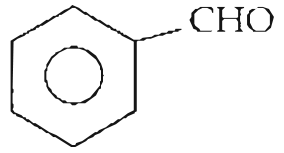
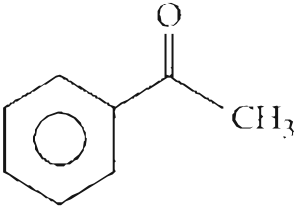
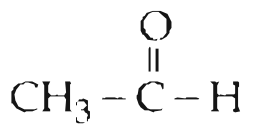
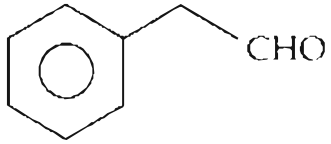
The compounds which give positive Fehling's test are : (A) $\mathrm{C_6H_5-CHO}$ (B) $\mathrm{C_6H_5-C(=O)-CH_3}$ (C) $\mathrm{HOCH_2-CO-(CHOH)_3-CH_2-OH}$ (D) $\mathrm{CH_3-C(=O)-H}$ (E) $\mathrm{C_6H_5-CH_2-CHO}$. Choose the correct answer from the options given below :
(1)(A), (D) and (E) Only
(2)(C), (D) and (E) Only
(3)(A), (C) and (D) Only
(4)(A), (B) and (C) Only
Show answer and solution
Correct answer: (2)
Topic: Oxidation of Aldehydes and Ketones
Fehling's alkaline copper(II) reagent gives a brick-red $\mathrm{Cu_2O}$ precipitate with most **aliphatic aldehydes** and with reducing carbohydrates that can form aldehydes in alkali. Inspect the original structural formulas one by one:
- **(A)** $\mathrm{C_6H_5CHO}$ is benzaldehyde. Its aldehyde carbonyl is attached directly to the aromatic ring, and it normally gives a **negative** Fehling test.
- **(B)** $\mathrm{C_6H_5COCH_3}$ is acetophenone, an ordinary ketone; it gives a **negative** result.
- **(C)** $\mathrm{HOCH_2CO(CHOH)_3CH_2OH}$ is the open-chain ketose fructose. In alkaline medium, enediol rearrangement produces reducing aldose forms, so it is **positive**.
- **(D)** $\mathrm{CH_3CHO}$ is ethanal, an aliphatic aldehyde. It reduces $\mathrm{Cu^{2+}}$ to $\mathrm{Cu_2O}$ and is **positive**.
- **(E)** $\mathrm{C_6H_5CH_2CHO}$ is phenylacetaldehyde. The aldehyde is separated from the aromatic ring by $\mathrm{CH_2}$, so it behaves as an aliphatic aldehyde and is **positive**.
The positive set is $\boxed{\mathrm{(C),(D),(E)}}$, giving **option (2)**. Choice (1) includes negative A; (3) includes negative A and omits E; (4) includes negative A and B while omitting D and E.
Q58ElectrochemistrySingle correct
Which of the following electrolyte can be used to obtain $\mathrm{H_2S_2O_8}$ by the process of electrolysis?
(1)Dilute solution of sodium sulphate.
(2)Acidified dilute solution of sodium sulphate.
(3)Dilute solution of sulphuric acid
(4)Concentrated solution of sulphuric acid
Show answer and solution
Correct answer: (4)
Topic: Electrolytic Cells and Electrolysis
Peroxodisulphuric acid, $\mathrm{H_2S_2O_8}$, is made by electrolytic anodic oxidation of **concentrated sulphuric acid**, which supplies abundant hydrogen sulphate ions, $\mathrm{HSO_4^-}$. At the anode, two hydrogen sulphate ions couple and release two electrons:
$$2\,\mathrm{HSO_4^-}\longrightarrow\mathrm{H_2S_2O_8}+2e^-.$$
The newly formed peroxo linkage is $\mathrm{-O-O-}$. The cathode reaction is
$$2\,\mathrm{H^+}+2e^-\longrightarrow\mathrm{H_2}\uparrow.$$
Both half-reactions balance atoms and charge; the anodic reaction is the source of peroxodisulphuric acid. In dilute aqueous electrolytes, competing water oxidation generally predominates instead. Therefore **option (4), concentrated solution of sulphuric acid**, is correct. Options (1) and (2) use dilute sodium sulphate solutions, and (3) uses dilute sulphuric acid; none provides the required concentrated-acid conditions.
Q59Haloalkanes and HaloarenesSingle correct
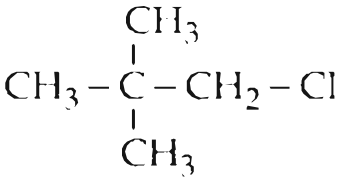
Given below are two statements : Statement I : $\mathrm{CH_3-O-CH_2-Cl}$ will undergo $S_\mathrm{N}1$ reaction though it is a primary halide. Statement II : $\mathrm{(CH_3)_3C-CH_2-Cl}$ will not undergo $S_\mathrm{N}2$ reaction very easily though it is a primary halide. In the light of the above statements, choose the most appropriate answer from the options given below :
(1)Both Statement I and Statement II are incorrect
(2)Both Statement I and Statement II are correct
(3)Statement I is incorrect but Statement II is correct
(4)Statement I is correct but Statement II is incorrect
Show answer and solution
Correct answer: (2)
Topic: SN1 Mechanism
**Statement I:** $\mathrm{CH_3-O-CH_2-Cl}$ is methoxymethyl chloride. Although the chloride-bearing carbon is primary, departure of $\mathrm{Cl^-}$ gives a cation whose positive charge is resonance-stabilized by the adjacent ether oxygen:
$$\mathrm{CH_3-O-CH_2^+}\ \longleftrightarrow\ \mathrm{CH_3-O^+=CH_2}.$$
The resulting oxocarbenium stabilization makes an $S_\mathrm N1$ pathway possible despite the primary classification. **Statement I is true.**
**Statement II:** $\mathrm{(CH_3)_3C-CH_2-Cl}$ is neopentyl chloride. The bonded $\mathrm{CH_2}$ carbon is primary, but its immediately adjacent $\mathrm{C(CH_3)_3}$ group creates severe steric hindrance. Backside nucleophilic attack required for $S_\mathrm N2$ substitution is consequently unusually slow. **Statement II is true.**
Both assertions are correct; thus the answer is $\boxed{\text{option (2)}}$. Option (1) rejects both statements, while options (3) and (4) each reject one true statement.
Q60BiomoleculesSingle correct
Which of the following acids is a vitamin?
(1)Adipic acid
(2)Ascorbic acid
(3)Saccharic acid
(4)Aspartic acid
Show answer and solution
Correct answer: (2)
Topic: Vitamins
The acid known as **vitamin C** is **ascorbic acid**, a water-soluble nutrient that participates in collagen biosynthesis and acts as a reducing agent. Check each given acid:
- **(1) Adipic acid:** $\mathrm{HOOC-(CH_2)_4-COOH}$ is a dicarboxylic acid, not a vitamin.
- **(2) Ascorbic acid:** this is vitamin C — **correct**.
- **(3) Saccharic (glucaric) acid:** a product of oxidation of sugar terminal groups, not itself a vitamin.
- **(4) Aspartic acid:** an amino acid, not a vitamin.
Therefore $\boxed{\text{option (2): ascorbic acid}}$.
Q61Classification of Elements and Periodicity in PropertiesSingle correct
Match List-I with List-II.
$$\begin{array}{ll}
\textit{List - I} & \textit{cList - II} \\
(A)\;\mathrm{Al^{3+}<Mg^{2+}<Na^+<F^-} & (I)\;\text{IonisationEnthalpy} \\
(B)\;\mathrm{B<C<O<N} & (II)\;\text{Metalliccharacter} \\
(C)\;\mathrm{B<Al<Mg<K} & (III)\;\text{Electronegativity} \\
(D)\;\mathrm{Si<P<S<Cl} & (IV)\;\text{Ionicradii}
\end{array}$$
Choose the correct answer from the options given below :
(1)(A)-(IV), (B)-(I), (C)-(II), (D)-(III)
(2)(A)-(IV), (B)-(I), (C)-(III), (D)-(II)
(3)(A)-(III), (B)-(IV), (C)-(II), (D)-(I)
(4)(A)-(II), (B)-(III), (C)-(IV), (D)-(I)
Show answer and solution
Correct answer: (1)
Topic: Periodic trends in properties
There are four distinct periodic trends to match. (A) Each ion has ten electrons. Within an isoelectronic series, a larger nuclear charge attracts the same electron cloud more strongly. Since $Z(\mathrm{Al})=13$, $Z(\mathrm{Mg})=12$, $Z(\mathrm{Na})=11$ and $Z(\mathrm{F})=9$,
$$r(\mathrm{Al^{3+}})<r(\mathrm{Mg^{2+}})<r(\mathrm{Na^+})<r(\mathrm{F^-}),$$
so (A) matches ionic radii, (IV).
(B) The first ionisation enthalpies follow $\mathrm{B<C<O<N}$. In particular, the half-filled $2p^3$ subshell of N makes removing its first electron harder than removing a paired $2p$ electron from O. Therefore (B) matches (I), ionisation enthalpy.
(C) Metallic character grows towards the left across a period and down a group; accordingly $\mathrm{B<Al<Mg<K}$ represents metallic character, (II).
(D) Electronegativity increases across the third period: $\chi(\mathrm{Si})\approx1.90<\chi(\mathrm{P})\approx2.19<\chi(\mathrm{S})\approx2.58<\chi(\mathrm{Cl})\approx3.16$. Thus (D) matches electronegativity, (III).
The complete mapping is
$$\boxed{(A)-(IV),\ (B)-(I),\ (C)-(II),\ (D)-(III)}.$$
Only **option (1)** has all four matches; options (2), (3) and (4) misassign at least two properties.
Q62Chemical KineticsSingle correct
Which of the following statement is not true for radioactive decay?
(1)Decay constant increases with increase in temperature.
(2)Amount of radioactive substance remained after three half lives is $\frac{1}{8}$ th of original amount.
(3)Decay constant does not depend upon temperature.
(4)Half life is $\ln 2$ times of $\frac{1}{\text{rate constant}}$.
Show answer and solution
Correct answer: (1)
Topic: Half-Life
For a radioactive nuclide undergoing ordinary nuclear decay, the number of undecayed nuclei obeys
$$\frac{dN}{dt}=-\lambda N,\qquad N(t)=N_0e^{-\lambda t},$$
where $\lambda$ is the decay constant. Nuclear decay is not an ordinary thermally activated chemical process; to the usual exam approximation, $\lambda$ is independent of sample temperature. Thus statement **(1)** is false and statement **(3)** is true.
Putting $N(t_{1/2})=N_0/2$ gives $e^{-\lambda t_{1/2}}=1/2$, hence
$$t_{1/2}=\frac{\ln 2}{\lambda}.$$
This confirms statement (4), interpreting the 'rate constant' as $\lambda$. After three successive half-lives,
$$\frac{N(3t_{1/2})}{N_0}=\left(\frac12\right)^3=\frac18,$$
so statement (2) is true as well. **Only option (1) is not true**, as required.
Q63AminesSingle correct
$$\mathrm{C_6H_5NO_2} \xrightarrow[\substack{\mathrm{(iii)\ NaNO_2,\ HCl,\ 273\ K}\\\mathrm{(iv)\ C_2H_5OH}}]{\substack{\mathrm{(i)\ Br_2,\ AcOH}\\\mathrm{(ii)\ Sn,\ HCl}}} A+B$$
The products formed in the following reaction sequence are :
Apply the four reagents in the indicated order, beginning with nitrobenzene, $\mathrm{C_6H_5NO_2}$.
1. The strongly deactivating $-\mathrm{NO_2}$ group directs electrophilic bromination to the **meta** position. $\mathrm{Br_2/AcOH}$ therefore produces 3-bromonitrobenzene, $\mathrm{3{-}BrC_6H_4NO_2}$.
2. $\mathrm{Sn/HCl}$ reduces $-\mathrm{NO_2}$ to $-\mathrm{NH_2}$ while retaining the aryl bromine, giving 3-bromoaniline.
3. At $273\,\mathrm K$, $\mathrm{NaNO_2/HCl}$ converts the primary aromatic amine to a diazonium salt:
$$\mathrm{3{-}BrC_6H_4NH_2}\ \longrightarrow\ \mathrm{3{-}BrC_6H_4N_2^+Cl^-}.$$
4. Ethanol acts as a reducing agent towards the diazonium salt. The diazonium group is replaced by H, releasing nitrogen, while ethanol is oxidised to ethanal:
$$\mathrm{ArN_2^+Cl^-+CH_3CH_2OH\longrightarrow ArH+N_2+CH_3CHO+HCl},\qquad \mathrm{Ar=3{-}BrC_6H_4}.$$
Therefore $A=\mathrm{C_6H_5Br}$ (**bromobenzene**) and $B=\mathrm{CH_3CHO}$ (**ethanal**): **option (3)**. Option (1) wrongly predicts a bromophenol; (2) a bromoethoxybenzene and ethanoic acid; (4) phenolic and ethoxy aromatic products. None follows from reductive dediazoniation with ethanol.
Q64Organic Chemistry – Some Basic Principles and TechniquesSingle correct
How many different stereoisomers are possible for the given molecule?
$$\mathrm{CH_3{-}CH(OH){-}CH{=}CH{-}CH_3}$$
(1)2
(2)1
(3)4
(4)3
Show answer and solution
Correct answer: (3)
Topic: Isomerism
The molecule is $\mathrm{CH_3{-}CH(OH){-}CH{=}CH{-}CH_3}$, or pent-3-en-2-ol. Carbon-2 is attached to four different groups: $-\mathrm{OH}$, $-\mathrm H$, $-\mathrm{CH_3}$ and $-\mathrm{CH{=}CH{-}CH_3}$. It is therefore one asymmetric centre, with configurations $R$ and $S$.
The $\mathrm{C_3=C_4}$ bond also exhibits geometrical isomerism: at C-3 the substituents are H and the C-2 chain; at C-4 they are H and $\mathrm{CH_3}$. Both alkene carbons thus have distinct substituents, allowing $E$ and $Z$ configurations. These two stereochemical choices are independent, so
$$N=2\text{ (optical)}\times2\text{ (geometrical)}=\boxed4.$$
The four distinct isomers are $(2R,3E)$, $(2S,3E)$, $(2R,3Z)$ and $(2S,3Z)$. There is no internal symmetry to create a meso form. Therefore **option (3)** is correct; options (1), (2) and (4) undercount the isomers.
Q65Single correct
A vessel at 1000 K contains $\mathrm{CO_2}$ with a pressure of 0.5 atm. Some of $\mathrm{CO_2}$ is converted into CO on addition of graphite. If total pressure at equilibrium is 0.8 atm, then $K_p$ is :
(1)1.8 atm
(2)0.3 atm
(3)3 atm
(4)0.18 atm
Show answer and solution
Correct answer: (1)
Solid graphite reacts with carbon dioxide through the Boudouard equilibrium,
$$\mathrm{CO_2(g)+C(s)\rightleftharpoons2CO(g)}.$$
The vessel is rigid and at $1000\,\mathrm K$, so the gas partial pressures can be used for an ICE table. Write $x$ (in atm) for the fall in the partial pressure of $\mathrm{CO_2}$. Starting with $0.5\,\mathrm{atm}$ of pure $\mathrm{CO_2}$ gives, at equilibrium,
$$p_{\mathrm{CO_2}}=0.5-x,\qquad p_{\mathrm{CO}}=2x,\qquad p_{\mathrm{total}}=0.5+x.$$
The measured $p_{\mathrm{total}}=0.8\,\mathrm{atm}$ implies $x=0.3\,\mathrm{atm}$; hence $p_{\mathrm{CO_2}}=0.2\,\mathrm{atm}$ and $p_{\mathrm{CO}}=0.6\,\mathrm{atm}$. The pure solid has unit activity, so the pressure-based equilibrium constant is
$$K_p=\frac{p_{\mathrm{CO}}^2}{p_{\mathrm{CO_2}}}=\frac{(0.6\,\mathrm{atm})^2}{0.2\,\mathrm{atm}}=\boxed{1.8\,\mathrm{atm}}.$$
Thus **option (1)**. Options (2), (3) and (4) give incompatible equilibrium pressure ratios. The thermodynamic dimensionless form, with $p^\circ=1\,\mathrm{atm}$, has numerical value $1.8$.
Q66ElectrochemistrySingle correct
A solution of aluminium chloride is electrolysed for 30 minutes using a current of 2 A. The amount of the aluminium deposited at the cathode is [Given : molar mass of aluminium and chlorine are $27\,\mathrm{g\,mol^{-1}}$ and $35.5\,\mathrm{g\,mol^{-1}}$ respectively. Faraday constant $=96500\,\mathrm{C\,mol^{-1}}$]
(1)1.660 g
(2)0.336 g
(3)0.441 g
(4)1.007 g
Show answer and solution
Correct answer: (2)
Topic: Faraday Laws of Electrolysis
For the idealised aluminium electrodeposition specified in this Faraday-law problem, the cathodic reaction is
$$\mathrm{Al^{3+}+3e^-\longrightarrow Al(s)}.$$
It requires three moles of electrons to deposit one mole of Al. Convert the time to seconds and calculate the charge:
$$t=30\times60=1800\,\mathrm s,\qquad Q=It=(2\,\mathrm A)(1800\,\mathrm s)=3600\,\mathrm C.$$
With Faraday constant $F=96500\,\mathrm{C\,mol^{-1}}$ and molar mass $M_{\mathrm{Al}}=27\,\mathrm{g\,mol^{-1}}$,
$$n(\mathrm{Al})=\frac{Q}{3F}=\frac{3600}{3(96500)}\,\mathrm{mol},$$
$$m_{\mathrm{Al}}=\frac{Q M_{\mathrm{Al}}}{3F}=\frac{3600\times27}{3\times96500}=0.335751\ldots\,\mathrm g\approx\boxed{0.336\,\mathrm g}.$$
Therefore **option (2)**. Options (1), (3) and (4) do not satisfy the $3e^-$ stoichiometry. The calculation uses the intended ideal assumption that all the passed charge reduces aluminium ions (100% current efficiency for the stated cathodic process).
Q67Organic Chemistry – Some Basic Principles and TechniquesOne or more correct
$$\mathrm{CH_3{-}CH(COOH){-}CH_2{-}CH_2{-}CH(COOCH_3){-}CH_3}$$
The IUPAC name of the following compound is :
Write the given displayed structure in the direction joining its two carbonyl groups:
$$\mathrm{HOOC{-}CH(CH_3){-}CH_2{-}CH_2{-}CH(CH_3){-}C(=O)OCH_3}.$$
The free carboxylic acid is the highest-priority functional group. Number its carbonyl carbon C-1; the continuous principal chain extends to the ester carbonyl at C-6. There is one methyl substituent at C-2 and another at C-5. The C-6 terminal carbonyl is described by $6$-oxo, and its attached $-\mathrm{OCH_3}$ substituent by $6$-methoxy. In prefix order the systematic acid name is
$$\boxed{\text{6-methoxy-2,5-dimethyl-6-oxohexanoic acid}}.$$
Since the same six-carbon chain has acid and methyl-ester termini, the equivalent diacid-derived name is **methyl hydrogen 2,5-dimethylhexanedioate**.
None of the four offered names describes this molecular connectivity correctly. Option (1) places the carboxy substituent and parent ester chain incorrectly; option (2) chooses a hexane parent rather than the senior carboxylic acid; option (3) uses an additional *methoxycarbonyl* group rather than the terminal methoxy/oxo substitution at C-6; option (4) gives an incompatible carbon skeleton/substitution pattern. The correct answer is the systematic name above, **not a numbered option**.
Q68Coordination CompoundsSingle correct
In which of the following complexes the CFSE, $\Delta_o$ will be equal to zero?
(1)$[\mathrm{Fe(en)_3}]\mathrm{Cl_3}$
(2)$\mathrm{K_4[Fe(CN)_6]}$
(3)$[\mathrm{Fe(NH_3)_6}]\mathrm{Br_2}$
(4)$\mathrm{K_3[Fe(SCN)_6]}$
Show answer and solution
Correct answer: (4)
Topic: Crystal Field Theory
For an octahedral complex, the crystal-field stabilisation energy excluding pairing energy is
$$\mathrm{CFSE}=\left(-0.4n_{t_{2g}}+0.6n_{e_g}\right)\Delta_o.$$
Evaluate the iron oxidation state and $d$-electron count in each option.
- **(1)** $[\mathrm{Fe(en)_3}]\mathrm{Cl_3}$ contains $\mathrm{Fe^{3+}}$ ($d^5$). Under the strong-field, low-spin reading for the chelating en ligand, its occupancy is $t_{2g}^5e_g^0$, with $\mathrm{CFSE}=-2.0\Delta_o$, not zero.
- **(2)** $\mathrm{K_4[Fe(CN)_6]}$ contains $\mathrm{Fe^{2+}}$ ($d^6$). Strong-field $\mathrm{CN^-}$ gives low-spin $t_{2g}^6e_g^0$, with $\mathrm{CFSE}=-2.4\Delta_o$.
- **(3)** $[\mathrm{Fe(NH_3)_6}]\mathrm{Br_2}$ contains $\mathrm{Fe^{2+}}$ ($d^6$). Its high-spin $t_{2g}^4e_g^2$ configuration has $\mathrm{CFSE}=-0.4\Delta_o$; even a low-spin $d^6$ configuration has nonzero CFSE.
- **(4)** $\mathrm{K_3[Fe(SCN)_6]}$ contains $\mathrm{Fe^{3+}}$ ($d^5$). Weak-field $\mathrm{SCN^-}$ produces high-spin $t_{2g}^3e_g^2$, and therefore
$$\mathrm{CFSE}=3(-0.4\Delta_o)+2(+0.6\Delta_o)=\boxed0.$$
Thus **option (4)**, $\mathrm{K_3[Fe(SCN)_6]}$, is the intended zero-CFSE complex.
Q69SolutionsSingle correct
Arrange the following solutions in order of their increasing boiling points.
(i) $10^{-4}\,\mathrm{M}$ NaCl
(ii) $10^{-4}\,\mathrm{M}$ Urea
(iii) $10^{-3}\,\mathrm{M}$ NaCl
(iv) $10^{-2}\,\mathrm{M}$ NaCl
(1)(i) < (ii) < (iii) < (iv)
(2)(iv) < (iii) < (i) < (ii)
(3)(ii) < (i) $\equiv$ (iii) < (iv)
(4)(ii) < (i) < (iii) < (iv)
Show answer and solution
Correct answer: (4)
Topic: Elevation of Boiling Point
For solutions of the same solvent, the dilute-solution boiling-point elevation is
$$\Delta T_b=iK_b m,$$
where $m$ is molality and $i$ is the van't Hoff factor. At such low concentrations, molality follows the same ordering as molarity. Urea is a nonelectrolyte, so $i\approx1$; NaCl yields $\mathrm{Na^+}$ and $\mathrm{Cl^-}$ and has $i\approx2$.
Compare $i\times c$ (in $\mathrm{mol\,L^{-1}}$) for each solution:
$$\begin{aligned}
\mathrm{(ii):}\quad &1(10^{-4})=10^{-4},\\
\mathrm{(i):}\quad &2(10^{-4})=2\times10^{-4},\\
\mathrm{(iii):}\quad &2(10^{-3})=2\times10^{-3},\\
\mathrm{(iv):}\quad &2(10^{-2})=2\times10^{-2}.
\end{aligned}$$
Larger effective particle concentration gives a larger $\Delta T_b$, so the increasing boiling-point order is
$$\boxed{\mathrm{(ii)<(i)<(iii)<(iv)}}.$$
This is **option (4)**. Option (1) reverses (i) and (ii), option (2) orders the concentrations backwards, and option (3) incorrectly equates (i) and (iii).
Q70Coordination CompoundsSingle correct
From the magnetic behaviour of $[\mathrm{NiCl_4}]^{2-}$ (paramagnetic) and $[\mathrm{Ni(CO)_4}]$ (diamagnetic), choose the correct geometry and oxidation state.
In $[\mathrm{NiCl_4}]^{2-}$, four $\mathrm{Cl^-}$ ions contribute $-4$ charge. Let Ni have oxidation state $x$:
$$x-4=-2\quad\Rightarrow\quad x=+2.$$
Hence the metal is Ni(II), $3d^8$. Chloride is a weak-field ligand, and this four-coordinate complex is **tetrahedral** with two unpaired $d$ electrons, consistent with the given paramagnetism.
In neutral $[\mathrm{Ni(CO)_4}]$, all carbonyl ligands are neutral, so nickel is **Ni(0)**, $3d^{10}$. The four neutral CO ligands donate eight electrons to the ten valence electrons of Ni, giving an 18-electron **tetrahedral** complex; all electrons are paired, explaining diamagnetism.
Therefore
$$\boxed{[\mathrm{NiCl_4}]^{2-}:\ \mathrm{Ni(II),\ tetrahedral};\qquad[\mathrm{Ni(CO)_4}]:\ \mathrm{Ni(0),\ tetrahedral}}.$$
This is **option (3)**. Option (1) assigns the wrong oxidation state and geometry to the carbonyl, (2) wrongly invokes square-planar arrangements, and (4) incorrectly makes the chlorido complex Ni(0) and the carbonyl square planar.
Q71Chemical Bonding and Molecular StructureNumerical
The number of molecules/ions that show linear geometry among the following is ________ $\mathrm{SO_2, BeCl_2, CO_2, N_3^-, NO_2, F_2O, XeF_2, NO_2^+, I_3^-, O_3}$
Show answer and solution
Correct answer: 6
Topic: VSEPR Theory
Examine the geometry around the central atom of each of the ten species using VSEPR and known resonance structures.
**Linear:** $\mathrm{BeCl_2}$ (two bonding regions, AX$_2$), $\mathrm{CO_2}$ (two double-bond electron regions at C), $\mathrm{N_3^-}$ (linear azide anion), $\mathrm{XeF_2}$ (AX$_2$E$_3$; the three lone pairs occupy equatorial sites), $\mathrm{NO_2^+}$ (nitronium; AX$_2$), and $\mathrm{I_3^-}$ (AX$_2$E$_3$).
**Bent (not linear):** $\mathrm{SO_2}$ (a central lone pair), neutral $\mathrm{NO_2}$ (odd-electron radical with bent geometry), $\mathrm{F_2O}$ (two lone pairs on oxygen), and $\mathrm{O_3}$ (a central lone pair).
The complete count is therefore
$$N_{\mathrm{linear}}=\underbrace{1+1+1+1+1+1}_{\mathrm{BeCl_2,\ CO_2,\ N_3^-,\ XeF_2,\ NO_2^+,\ I_3^-}}=\boxed6.$$
The numerical answer is **6**.
Q72Chemical KineticsNumerical
$A\to B$ The molecule A changes into its isomeric form B by following a first order kinetics at a temperature of 1000 K. If the energy barrier with respect to reactant energy for such isomeric transformation is $191.48\,\mathrm{kJ\,mol^{-1}}$ and the frequency factor is $10^{20}$, the time required for 50% molecules of A to become B is ________ picoseconds (nearest integer). [$R=8.314\,\mathrm{J\,K^{-1}\,mol^{-1}}$]
Show answer and solution
Correct answer: 70
Topic: Arrhenius Equation
For a first-order isomerisation, the Arrhenius rate constant is
$$k=Ae^{-E_a/(RT)}.$$
The barrier must be expressed in joules per mole:
$$E_a=191.48\,\mathrm{kJ\,mol^{-1}}=191480\,\mathrm{J\,mol^{-1}}.$$
Using $A=10^{20}\,\mathrm{s^{-1}}$, $R=8.314\,\mathrm{J\,K^{-1}\,mol^{-1}}$ and $T=1000\,\mathrm K$,
$$k=10^{20}\exp\!\left(-\frac{191480}{8.314(1000)}\right)=9.9483233428\times10^9\,\mathrm{s^{-1}}.$$
For half of A to be transformed, $[A]/[A]_0=1/2$. The integrated first-order law gives
$$\frac12=e^{-kt_{1/2}}\quad\Rightarrow\quad t_{1/2}=\frac{\ln2}{k}=6.96747739973\times10^{-11}\,\mathrm s.$$
Convert $1\,\mathrm{ps}=10^{-12}\,\mathrm s$:
$$t_{1/2}=69.6747739973\,\mathrm{ps}.$$
The required **nearest integer** is $\boxed{70\,\mathrm{ps}}$, so enter **70**.
Q73AminesNumerical
Consider the following sequence of reactions :
$$\mathrm{C_6H_5{-}NO_2}\xrightarrow[\substack{\text{(iii) }\mathrm{Cu_2Cl_2}\\\text{(iv) }\mathrm{Na,\ Ether}}]{\substack{\text{(i) }\mathrm{Sn+HCl}\\\text{(ii) }\mathrm{NaNO_2,\ HCl}\\0^{\circ}\mathrm{C}}}\underset{\text{Product}}{A}$$
Molar mass of the product formed $(A)$ is _______ $\mathrm{g\,mol^{-1}}$.
Show answer and solution
Correct answer: 154
Topic: Reactions of Diazonium Salts
Start with nitrobenzene, $\mathrm{C_6H_5NO_2}$, and follow the four steps shown.
1. $\mathrm{Sn/HCl}$ reduces the aromatic nitro group to an amino group: $\mathrm{C_6H_5NO_2\to C_6H_5NH_2}$ (aniline).
2. $\mathrm{NaNO_2/HCl}$ at $0^\circ\mathrm C$ diazotises the primary aromatic amine, giving benzenediazonium chloride, $\mathrm{C_6H_5N_2^+Cl^-}$.
3. $\mathrm{Cu_2Cl_2}$ carries out Sandmeyer chlorination; the diazonium group is replaced by Cl to form chlorobenzene, $\mathrm{C_6H_5Cl}$.
4. With sodium in dry ether, two aryl-halide molecules couple in a Fittig reaction:
$$2\,\mathrm{C_6H_5Cl}+2\,\mathrm{Na}\longrightarrow \mathrm{C_6H_5{-}C_6H_5}+2\,\mathrm{NaCl}.$$
The final product $A$ is **biphenyl**, with molecular formula $\mathrm{C_{12}H_{10}}$. Taking $M(\mathrm C)=12$ and $M(\mathrm H)=1$ in $\mathrm{g\,mol^{-1}}$,
$$M(A)=12(12)+10(1)=\boxed{154\,\mathrm{g\,mol^{-1}}}.$$
Enter the numerical answer **154**.
Q74Some Basic Concepts of ChemistryNumerical
Some $\mathrm{CO_2}$ gas was kept in a sealed container at a pressure of 1 atm and at 273 K. This entire amount of $\mathrm{CO_2}$ gas was later passed through an aqueous solution of $\mathrm{Ca(OH)_2}$. The excess unreacted $\mathrm{Ca(OH)_2}$ was later neutralized with 0.1 M of 40 mL HCl. If the volume of the sealed container of $\mathrm{CO_2}$ was $x$, then $x$ is ________ $\mathrm{cm^3}$ (nearest integer). [Given : The entire amount of $\mathrm{CO_2\,(g)}$ reacted with exactly half the initial amount of $\mathrm{Ca(OH)_2}$ present in the aqueous solution.]
Show answer and solution
Correct answer: 45
Topic: Mass-mass and mass-volume stoichiometry
The carbon dioxide is completely consumed by calcium hydroxide according to
$$\mathrm{CO_2+Ca(OH)_2\longrightarrow CaCO_3+H_2O},$$
a one-to-one mole ratio. Excess calcium hydroxide is subsequently neutralised by
$$\mathrm{Ca(OH)_2+2HCl\longrightarrow CaCl_2+2H_2O}.$$
The titration used $V_{\mathrm{HCl}}=40\,\mathrm{mL}=0.040\,\mathrm L$ at $0.1\,\mathrm{mol\,L^{-1}}$, so
$$n(\mathrm{HCl})=0.1\times0.040=0.004\,\mathrm{mol},\qquad n(\mathrm{Ca(OH)_2\ remaining})=\frac{0.004}{2}=0.002\,\mathrm{mol}.$$
The statement that CO$_2$ reacted with exactly half of the original Ca(OH)$_2$ means the reacted half and the unreacted half contain equal moles. Therefore
$$n(\mathrm{CO_2})=n(\mathrm{Ca(OH)_2\ reacted})=0.002\,\mathrm{mol}.$$
Use $PV=nRT$ at $P=1\,\mathrm{atm}$, $T=273\,\mathrm K$, and $R=0.082057\,\mathrm{L\,atm\,mol^{-1}\,K^{-1}}$:
$$V=\frac{(0.002)(0.082057)(273)}{1}\,\mathrm L=0.044803122\,\mathrm L=44.803122\,\mathrm{cm^3}.$$
The nearest integer is $\boxed{45\,\mathrm{cm^3}}$, giving numerical answer **45**.
Q75Organic Chemistry – Some Basic Principles and TechniquesNumerical
In Carius method for estimation of halogens, 180 mg of an organic compound produced 143.5 mg of AgCl. The percentage composition of chlorine in the compound is _______ %. (Given : molar mass in $\mathrm{g\,mol^{-1}}$ of Ag : 108, Cl : 35.5)
Show answer and solution
Correct answer: 20
Topic: Quantitative Analysis and Formula Determination
In the Carius method, the chlorine from the organic compound is precipitated as silver chloride, AgCl. The molar mass of the precipitate is
$$M(\mathrm{AgCl})=M(\mathrm{Ag})+M(\mathrm{Cl})=108+35.5=143.5\,\mathrm{g\,mol^{-1}}.$$
A sample producing $143.5\,\mathrm{mg}$ of AgCl therefore contains
$$m(\mathrm{Cl})=m(\mathrm{AgCl})\frac{M(\mathrm{Cl})}{M(\mathrm{AgCl})}=143.5\,\mathrm{mg}\times\frac{35.5}{143.5}=35.5\,\mathrm{mg}$$
of chlorine. The initial mass of organic compound was $180\,\mathrm{mg}$, so
$$\%\mathrm{Cl}=\frac{35.5}{180}\times100=19.7222\ldots\%.$$
Rounded to the whole-number response, this is $\boxed{20\%}$; enter **20**.
These papers are open for everyone. With an account you get all 60 JEE papers sorted chapter-wise and topic-wise, plus chapter trees, formula summaries and practice for JEE & NEET.
 JEE NEET AI